

Stay out of my life, you fucking idiot.
God willing, those will be the last words I ever say to my dad.
I thought pretty hard about whether I wanted to write and publish this article. I decided that it’s worth it, if only so that other people with tantrum-throwing, emotional toddlers for parents know that their experience was not unique. It’s typically considered in bad taste to speak about having bad parents, so the experience may seem more rare than it really is.
Growing up, the two most recurring memories I have of my dad were that he was constantly cheating on my mom and was constantly throwing temper-tantrums when something didn’t go his way. Some notable examples of the latter behavior: one time my mom brought the wrong kind of sunscreen to a theme park, which resulted in a 45 minute tirade in which the words “stupid bitch” were used more than once. They sold sunscreen at the gift shop.
Another time, I had used the last of the milk. I was probably in second or third grade and had no idea that I had done anything wrong. I woke up early one morning and poured some cereal, which was the last of the gallon that was in the fridge. My dad didn’t have any left for his own cereal. He threw a house-shaking temper-tantrum, although my mom was careful to redirect most of his anger towards her rather than me.
He threw a tantrum over a restaurant bill being too high, which he didn’t even pay for. He erupted when I accused him of lying after he had just told a blatant, demonstrable lie. I still remember his face when he looked at me and yelled “Are you calling me a liar!?”. That happened more than once. He punched holes in the wall over losing at internet Spades. He screamed at my mom after my sister witnessed him throw a shoe at her (“Look what you made me do!”). I only recently learned about the shoe-throwing incident.
There was one particular tirade that changed my perception of him forever, and also changed me forever. I was 9 or 10 years old, playing travel baseball. I had the worst game of my life, going 0 for 4 at the plate with three or four errors in the field. A good father would have used this as a learning opportunity about what to do when faced with setbacks. My father dragged me to the car by my arm and proceeded to scream at and belittle me for the next half an hour. I vividly remember watching the spittle fly from his lips as he screamed at me.
I don’t remember the details of what he said to me in that car. I just remember the general theme. He was embarrassed. I had embarrassed him because I had a bad game, and because of that, I—a 9 year old—apparently deserved to be belittled and berated by my 40 year old father.
As I cried in the backseat on our way home, I remember one specific thought: this isn’t right. I wasn’t old enough to understand how my dad was different, but I was old enough to understand that I didn’t deserve what he had done to me.
I changed after that event. I developed a kind of inferiority complex until sometime later in life. In junior high and high school, even though I was obviously doing fine—decent athlete, good group of friends, active dating life, academically gifted, etc.—I maintained a constant sense of inferiority. I remember thinking even at the time that this feeling was irrational, but I couldn’t shake it. I’ll come back to that later.
My mom eventually divorced him, with my encouragement. I remember her asking me if divorcing him would be OK, and I enthusiastically told her that she should. I had personally witnessed his cheating. One time I heard him talking to another woman on the phone at night, where I heard him call my mom a fat cow who never had sex with him. I confronted him crying about it, and he threatened to spank me if I told on him. I also had many vivid memories of his tantrums, towards both my mom and myself. I was 13 years old, but the decision to divorce him seemed obvious to me.
After the divorce, my mom never—or at least very rarely—talked bad about my dad to me, although he was constantly paranoid about her doing so. There were things he did that I didn’t learn about until much later in my life. For example, I only recently learned what happened in court when my dad found out he would have to pay $225/month in child support.
To begin, my dad refused to show up to the divorce proceedings. The judge eventually sent deputies to my mom’s house (which my dad refused to move out of despite never making a payment on it) in order to retrieve him. He was forced to come to court, where he then learned he would have to vacate the house and pay child support.
Upon learning that he would need to vacate the house in three days, he attempted to leave the courtroom. The bailiffs or deputies forced him to remain in his seat and held him by his shoulders. Upon learning of his $225/month child support payment, he fell to the floor and literally wailed in agony. He actually got on the ground in the fetal position and wept like a small child.
And this is understandable! While he was married, he hardly paid for anything. Now that she was divorcing him, he would be forced to actually provide for his child. The poor guy was flabbergasted.
I’m sure there are many other tantrums and affairs that I’ll never know about. I think my mom’s choice not to badmouth him when I was growing up was both admirable and strategically correct. She didn’t need to talk about him—his own behavior was enough to alienate me, which is eventually what happened.
As a teen, I began to realize that I didn’t have to put up with his mistreatment. I stood up to him, and he quickly realized that intimidation no longer worked on me. The frequency of his tantrums dropped considerably when he realized I was no longer scared of him.
But I still remembered, and things came to a head when I was 17 years old. I was with my dad while he was visiting a girlfriend. She had committed the grave error of attempting to listen to the music she liked on the radio. While I was growing up my dad chose what would play on the car radio, and any resistance would result in one of his man-baby-tantrums.
He began to throw one of these tantrums towards her while I was in the back seat. I told him to shut the fuck up, and made it clear that he would never speak to anyone that way in my presence again. His angry tantrum turned towards me, and I laughed in his face. When he realized that anger was no longer effective, he tried a new strategy—the solicitation of pity. I don’t remember the exact quotes, but it went something like this:
What have I done to deserve this? Haven’t I been a good dad to you? I’ve always tried my best. Why are you acting like this, Brett?
It was then that I realized how truly pathetic my dad was. It was almost funny how quickly his anger turned to self-pity when it became obvious that I wasn’t scared of him.
I was angry at him, but that anger was only a small portion of what I felt. I was mostly disgusted. I was nauseated that this poor excuse for a man was my father. Before leaving that night, I listed off everything I could think of that he had ever done to me and my mom. All the cheating, all the tantrums, the screaming after the baseball game. Did he apologize for anything? No. I did the best I could. That’s what he told me. If that was the truth, then his best just wasn’t good enough.
I disowned my dad that night and went no-contact. I cried very, very hard about that decision, but it was ultimately a great relief. It was as if a heavy weight had been removed from my chest. After that night I felt lighter, more confident, more at ease in my own skin. Although my self-esteem has had ups and downs like everyone’s, I never felt that irrational sense of inferiority again.
That was not the last time I spoke to my dad. I tentatively let him back into my life twice more (after going no-contact again the first time). I’ll skip the details and move on to the present day.
I am writing these words from my maternal grandmother’s house. She is in hospice care, and will die in the next few days1. She has lost the ability to speak, and I am watching over her on the night shift. By the time this is published, she will have passed away.
We had heard that some people from her old job were asking about her. They had learned she was in hospice care from my dad. I had told my dad about my grandma’s health situation, and he had told some people he knew. There was nothing wrong with him telling people. I never told him it was a secret, and I wasn’t upset that he told anyone.
However, both my grandma and our family are relatively private, and we weren’t telling everyone in town just yet. I called him and told him that I wasn’t mad at him for telling whoever he told, but to please not tell anyone else. This request was apparently very upsetting for him.
When I talked to him later on that day, he wouldn’t even let me get a word in. He was convinced that I was mad at him for telling people (even though I told him multiple times that I wasn’t mad at him), and was throwing a tantrum about it.
He made up a problem in his head. He then refused to allow me to clarify by talking over me while berating me about this made-up problem. When I did get a chance to speak, I told him that nobody was mad at him, that he did nothing wrong by telling people about my grandma, but that we just wanted him to not tell anyone else. That didn’t calm him down one bit, so at that point I was done with the conversation. My final words to him were:
Stay out of my life, you fucking idiot.
I hung up the phone, sent a final text, then blocked his number:
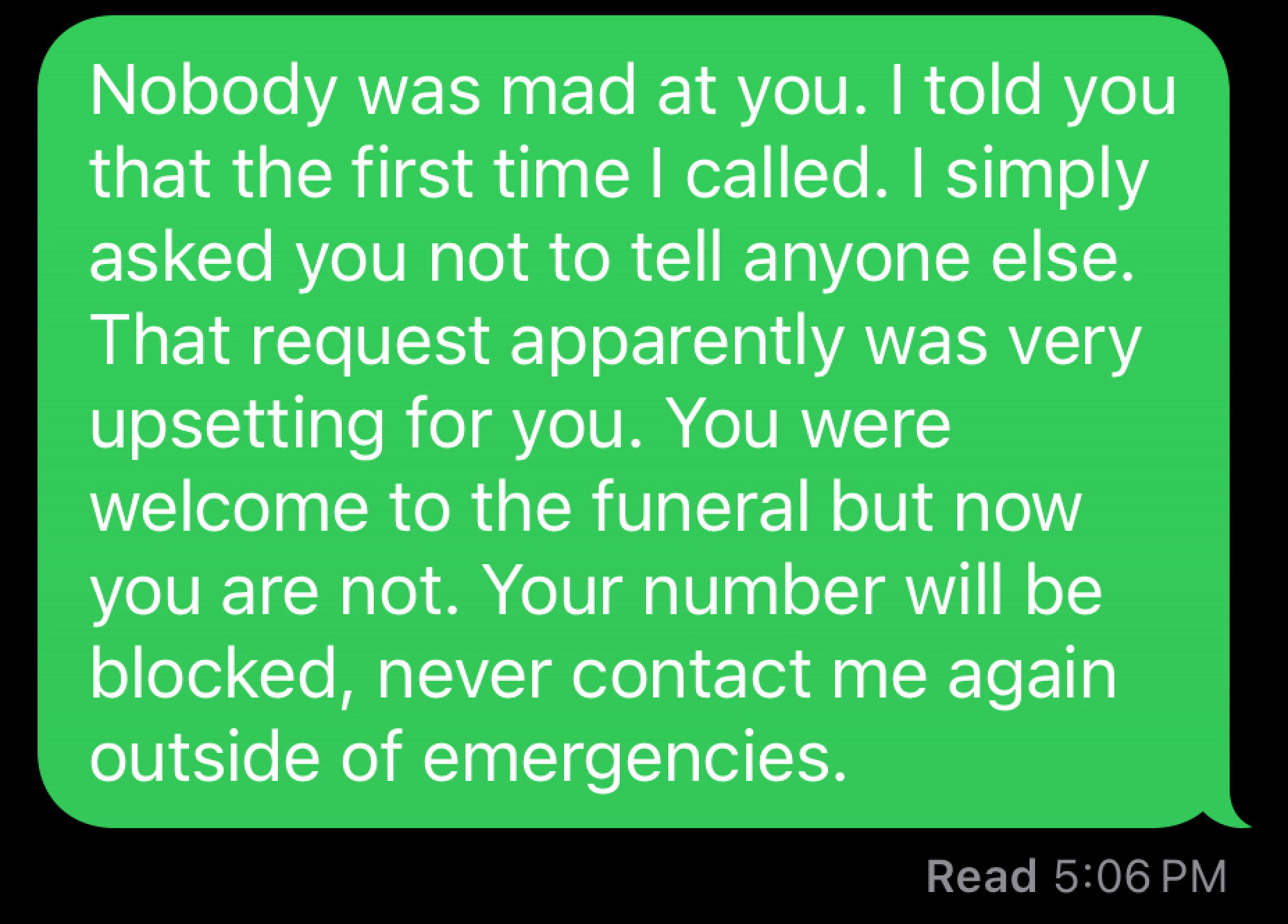
Let me tell you that I have never been less concerned about an apparently life-changing decision. I mourned the loss of my father when I was 17. At 34, it now feels like I just swatted a mosquito buzzing around my head. It’s just no big deal.
I should mention that my dad has one other child, my half-sister, who also doesn’t speak to him. I’m not close with her, but she witnessed much of the same behavior I did as a child and I suspect that her choice mirrors my own.
Explaining Bad Behavior
There are many frameworks by which you can try to understand someone’s behavior. Behavioral genetics is one, but in this case it’s not very enlightening. My dad’s two full brothers aren’t like him at all. Both of them have been (apparently) happily married for decades. His older brother is a calm, successful software engineer as well as a devout Christian and family man. His younger brother has been married to the same woman for decades, and I doubt that would be possible if he were throwing temper-tantrums and cheating all the time. My paternal grandfather died when my dad was very young, but from what I’ve heard he was a generally kind man, even if he did enjoy more than a few beers on the weekend.
To my knowledge, my dad is the only one in the family who turned out this way. I don’t rule out heritable factors just because he’s different from the rest of his family, but clearly there isn’t a simple 1:1 relationship between his genetic inheritance and his behavior.
I’ve been trying to understand why my dad is the way he is for years. I don’t necessarily have a causal explanation, but I do have an association I would like to explore in the rest of this article. I don’t think the temper-tantrums, cheating, lies, manipulation, etc., are fully separable from his values.
My dad never spoke about values, but values can be inferred relatively easily. Toward what ends does a person expend the most time, effort, and attention? People clearly value money, family, romance, and social acceptance because people spend lots of time and attention attaining and retaining them.
Toward what ends has my dad aimed? I’ve known him all my life, and there have been three constants which have always occupied the majority of his time and attention: beer, women, and sports. This is my dad’s holy trinity.

In fact, if I had made the image above for my dad he might have laughed at it in self-recognition. It’s not like he’s in denial about it. He likes what he likes.
He has never had a career, having worked as a pizza delivery driver most of his life. He neglected his family, and he has no creative pursuits. So how has he spent his time? Most nights that he doesn’t work have been spent drinking while watching some game, or drinking while trying to find a hooker or desperate woman to hook up with, or traveling to drink, watch sports, and/or hook up with some woman he met online.
I don’t want to caricature the man. He spent time with me growing up, though most of that time revolved around him trying to make me good at sports. And I appreciated that! I had a decent high school baseball career in large part because he worked with me as a kid. He spends time with some of his extended family these days too, though most of that also revolves around sports.
There’s nothing wrong with enjoying beer, women, or sports. I like all three. I just don’t spend most nights drinking, trying to hook up, or watching a game.
The Last Man
Readers of this blog will know that I often write about Nietzsche, who has been my most important intellectual influence. When I was first reading Nietzsche, I couldn’t help but notice how descriptions of the last man always reminded me of my dad. I never would have mentioned this connection while I still had something resembling a relationship with him, but that is no longer the case.
“Alas, the time is coming when man will no longer give birth to a star. Alas, the time of the most despicable man is coming, he that is no longer able to despise himself. Behold, I show you the last man.
“ ‘What is love? What is creation? What is longing? What is a star?’ thus asks the last man, and he blinks.
“The earth has become small, and on it hops the last man, who makes everything small.
“One has one’s little pleasure for the day and one’s little pleasure for the night: but one has a regard for health.
“‘We have invented happiness,’ say the last men, and they blink.”
(Zarathustra Prologue 6)
Nietzsche believed that our capacity for science and critical thinking had undermined the foundational beliefs upon which our highest cultural values had rested. In the wake of this intellectual undermining, modern man was faced with two equally untenable options2:
Engage in critical evaluation of our deepest beliefs and values, ultimately undermining them. This is the path of the last man.
Protect our deepest beliefs and values from critical evaluation, becoming a kind of fanatic in their service.
My dad engaged in the first option. He was raised in a deeply Christian family, and I remember his discussions of religion growing up. He talked about how the Bible was ridiculous, with earth-covering floods, people living to 900 years old, and all the other implausible events and miracles. He talked about how religious people were hypocrites, how he knew many people who engaged in all the bad behavior everyone else did, but went to church on Sunday and acted like they were saints.
My dad was not wrong. If you’re judging the stories from an empirical perspective, the Bible is obviously ridiculous. And many outwardly religious people are hypocrites. If Christianity is your source of higher values, this kind of critical reflection may successfully undermine them.
That undermining doesn’t need to be the end of the process. For Nietzsche, the goal was to pass through nihilism and to come out the other side with a more subtle, more complex, more sophisticated foundation for higher values. Unfortunately, that process may not be possible for everyone. Much of this blog (e.g., here, here, here, and here) is my attempt to frame such a foundation for myself, and for others who may resonate.
My dad’s older brother leaned heavily into his Christian upbringing. I suspect that isn’t unrelated to his stable career and family life. For my dad, I suspect that the absence of any source of higher values wasn’t unrelated to his unstable career and family life, and to his constant pursuit of comfort and pleasure.
My hypothesis is that in the absence of anything greater to strive for, my dad simply failed to grow up. Children throw tantrums, but adults learn to regulate their emotions. Children seek immediate gratification, but adults learn to sacrifice. My dad got better at these things as he got older, but in his 30s and 40s when I was growing up, he constantly failed at both.
He has basically admitted as much. As he got older he became more self-aware, and has told me that he felt like he never really grew up. I respect this kind of self-awareness. But it is, as they say, a day late and a dollar short.
What I want to impress upon you is that the last man—the man who lacks higher values—is not morally or ethically neutral. This lack of higher values is dangerous. Dostoevsky explored this fact in his books Crime and Punishment along with The Brothers Karamazov, famously implying that if God is dead, all is permitted.
If God is dead, all that may be left are short-term, hedonistic pursuits and the desire for comfort. And if those are your only concerns, what’s the point of integrity and responsibility? Integrity and responsibility require sacrifice, but why sacrifice when there is nothing on the altar?
Love and Loss
I love my dad. I always will. When the time comes where his life is nearing its end, I’ll be there for him if he wants me to be. I have lots of good memories with him, along with the bad.
But the fact is that he never really took responsibility for the way he treated me while I was growing up. As an adult, my relationship with him was always conditional. He would never get to throw another fit with me, or it was over. And to his credit, he held out for a pretty long time. He went perhaps ten years without so much as raising his voice.
If his most recent tantrum happened some other time, I might have tried a little harder to calm him down. I might have been more forgiving. But instead of understanding our wish for privacy, he took it personally and threw a man-tantrum while I was taking care of my dying grandmother. His selfishness is unacceptable, as it has always been.
When I was in high school, there was a time when we were asked who our heroes were. My best friend said that his dad was his hero, and that he wanted to be like him. I wasn’t jealous of my friend, but I always wondered what that experience would have been like.
My dad has served only as an example of what I do not want to be like. I do not want to live a life where ambition, responsibility, self-control, and integrity are absent. I want to strive for greatness even if I fail. I want to take on heavy burdens even if they require sacrifice. I want to control my emotions and desires rather than the other way around. I must live with integrity.
I’ve learned a lot from my dad.
I wrote the first draft Tuesday night while she slept. She passed away the next day, and I hit “publish” on Friday.
Giving this a "like" is one of those horribly modern and completely inadequate responses to this. I am just so lucky and grateful to destiny that I never had to go through that sort of thing (whatever faults or inadequacies one can always find in parents). Looking forward to Mr Andersen's book. (And by 'Mr Andersen' I do of course mean Brett and not his father.)
I've read all your articles and watched all your videos. I definitely wasn't expecting something like this after your absence here. I gotta say this is one of the best possible way you could make your comeback here. It's crazy to me to think that someone with the intellectual power to built an entire worldview had lived with the feeling of inferiority. Your intellectual work it's the best possible response to that. I related to a lot of what you said and we are about the same age, so I just want to encourage you to keep this great work. Just a few minutes after you posted this article your massage already crossed the ocean and hit very deep in someone who doesn't even share the same culture as you. Thank you so much for this. And sorry for the loss of your grandmother.