

For those of us who have examined the evidence, it’s not possible to really believe in the God of the Old Testament, the New Testament, the Quran, or any other holy book. In all cases, these books were written by men with all-too-human motivations, including the ongoing unification and expansion of Israel (for the Old Testament), the justification of the unexpected, brutal death of a beloved preacher-prophet, in addition to the expansion of the movement created in his name (for the New Testament), and the creation and expansion of a new religious empire (for the Quran).
For us, these books cannot be seen as divinely inspired, at least not in the way their adherents do. They aren’t non-fiction books, and pretending they are is unserious. That’s not to say there is no historical basis for the events depicted in these books, but it is to say that in all three cases the authors and editors have taken plenty of creative liberty to embellish, add, and subtract from whatever the actual historical record was.
I am therefore dismissive of any literal understanding of the purportedly holy books of the Abrahamic tradition. I am not, however, dismissive of the project of religion itself, of which the Abrahamic God is perhaps the most important manifestation.
In some form, religion—or something that closely resembles it—was, and is, necessary. It serves as a mechanism for the unification of disparate peoples, facilitates faithful transmission of traditions and social customs, and has provided a kind of palliative for the psychological ills brought on by the sudden advent of large, anonymous, multi-ethnic, stationary civilizations after millions of years of evolving for small group nomadic life.
I suspect that religion of some kind will always be an aspect of social life. It has always been in the past, and I doubt that will change much in the future. In the absence of traditional organized religion, human groups tend to create something that looks a hell of a lot like religion anyways:
Regardless, the fact remains that for us, the God of Abraham is not believable. One response to this loss of faith in religion has been to say that the universe now appears to be pointless. It has no direction, no purpose, and no story that we ought to be participating in. The universe must have popped into existence from nothing, for no particular reason. Someday it will fizzle out into nothingness in some anti-climactic heat death, having accomplished nothing along the way.
That does seem to be a common view among smart, scientifically minded atheists. Some version of the pointless universe has been put forward by Nobel-prize winner Steven Weinberg, Richard Dawkins, Carl Sagan, and plenty of others. While I agree that there is no top-down designer God consciously shaping our future, I’m not so sure about pointlessness. When I look at the big picture of the universe, the word “pointless” doesn’t come to mind.
There is directionality, or at least something that very much appears like it. Particles coalesce into atoms, then stars, galaxies, and eventually life. Out of simplicity emerges complexity. This apparent directionality even has a parallel in human history. Small bands of hunter-gatherers coalesced into tribes, then chiefdoms, and eventually form globe-spanning empires. Along with this increase in size and diversity comes a massive increase in specialization and technological sophistication. And that process is just the most recent manifestation of the entire history of life on Earth, where RNA (or something like it) became single-celled organisms, which became multicellular, then communal, all the way up to the emergence of the most complex species of all, which is us. Out of simplicity emerges complexity.
It’s not necessarily that the total complexity of the universe is increasing. Maybe it is and maybe it isn’t. It’s not even clear how one would measure something like that, and there are obviously pockets of the universe where local complexity decreases. What is obvious is that more complex entities appear to be emerging over time.
An increase in complexity can be understood as a simultaneous increase in both differentiation and integration. In that sense, an atom just is more complex than a sub-atomic particle, a star is more complex than an atom, and a galaxy is more complex than a star. Living things are more complex than non-living things, and among living things there is nothing we know of that is more complex than a human being and its massively interconnected brain. Human culture and civilization add a layer of complexity on top of that.
Among human groups, a chiefdom is more complex than a hunter-gatherer tribe, and a continent-spanning multi-ethnic empire is more complex than a chiefdom. Each is more differentiated (i.e., has more diversity within it) and more integrated (i.e., brings a larger number of parts into a coherent whole) than the last.
Recognition of this pattern doesn’t prove that complexification is the purpose of the universe. Perhaps, as Stephen Jay Gould pointed out, complexification is just a byproduct of the fact that everything starts out simple. If everything began with simplicity, there’s only one way to go—towards complexity. Gould’s argument is smart, and worth considering. His main point is obviously true. If the universe began with simplicity, then any deviation from that starting point can only be in the “direction” of more complexity. Duh.
I’ve changed my tune on this point a little bit since the last time I wrote about it. I think Gould is right, and that this does put a damper on calling this drive towards complexity a “purpose” of the universe. The drive towards complexity should not be thought of as the “purpose” of the universe—it just is the universe. More accurately, it is the omniverse, since our own universe is potentially the product of a multiverse spanning process of complexification, as will be explained below. There’s no need to smuggle a “purpose” into the process.
If that’s true, then all aspects of existence are manifestations of this process of complexification. Therefore,
existence = complexity
That will seem an odd equation, but it’s not new, nor is it mine. I first read a version of it in the physicist Lee Smolin’s 1997 book The Life of the Cosmos:
From the point of view of the old, Newtonian-style physics, the structure of the world is accidental… But… from the point of the view of the new physics, complexity must be an essential aspect of the organization of the world. Indeed, it is not only that a world with life must necessarily be complex… in the twentieth century our very understanding of space and time, of what it means to say where something is or when something happened, requires a complex world. (p. 16)
The universe cannot be said to “exist” unless it is complex. To say that a ‘thing’ exists is to say that it is differentiated and integrated to some degree, i.e., is complex. The process of complexification is therefore equivalent to the ongoing creation of our universe and, perhaps, all universes.
In that book, Smolin put forward a strange idea. He claims that our universe—including its particular laws of physics, which are likely to be different from other universes—may have been birthed from a black hole in another universe. This, he claims, may be the source of all universes. Smolin’s hypothesis is that every time a singularity spawns, a new universe is created with slightly different laws of physics from the parent universe.
Through this process, universes would evolve so that those universes which tend to spawn more black holes—which, for reasons explained in his book, also tend to be more complex—are those which proliferate. This idea may sound farfetched. While it’s not exactly mainstream science, it does have some things going for it. In fact, it has more going for it now in 2026 than it did in 1997 when that book was published.
In the first place, the idea that our universe is inside some kind of black hole—or just is a black hole—has gotten more popular among the relevant scientists, and is referred to as black hole cosmology or the Schwarzschild cosmology model. It’s still not the mainstream view, but mainstream physicists absolutely take it seriously. See Neil deGrasse Tyson discussing it below:
One interesting piece of evidence for this view is that if you calculate how large a black hole containing the same amount of matter as our universe ought to be, you end up with the actual size of our universe. Our universe is roughly the radius it ought to be if it were a black hole. The catch is that this is also a mathematical consequence of the universe being geometrically flat1, so it’s not exactly a smoking gun.
Physicist Nikodem Poplawski also argued that black hole cosmology solves one problem related to the big bang. Instead of the universe starting from an infinitely small point, Poplawski suggests that it may have started when a black hole in a "parent universe" squeezed matter so hard that it spring-loaded a Big Bounce into a new expanding universe.2 Basically, black hole cosmology avoids the need to posit an infinitely dense point—something that might be impossible—to begin the universe.
But much of Smolin’s theory still lacks empirical evidence. For example, even if black holes do spawn new universes, we have no empirical reason to believe that those universes end up with slightly different laws of physics, which is a necessary part of Smolin’s evolutionary theory.
Smolin’s theory would make a lot of sense (at least to me) if it were true, but we still don’t have enough evidence to either disconfirm or verify it. I bring it up only because, if something like it is true, then the process of complexification would be truly all-encompassing. Everything which exists in all universes would be a manifestation of the same general process of complexification.
That process has a shape, which we can understand scientifically. In his work on self-organized criticality, physicist Per Bak pointed out that complexification must occur at the border between order and chaos. Too much order invites uniformity, which isn’t complex, while too much chaos invites randomness, which isn’t complex.
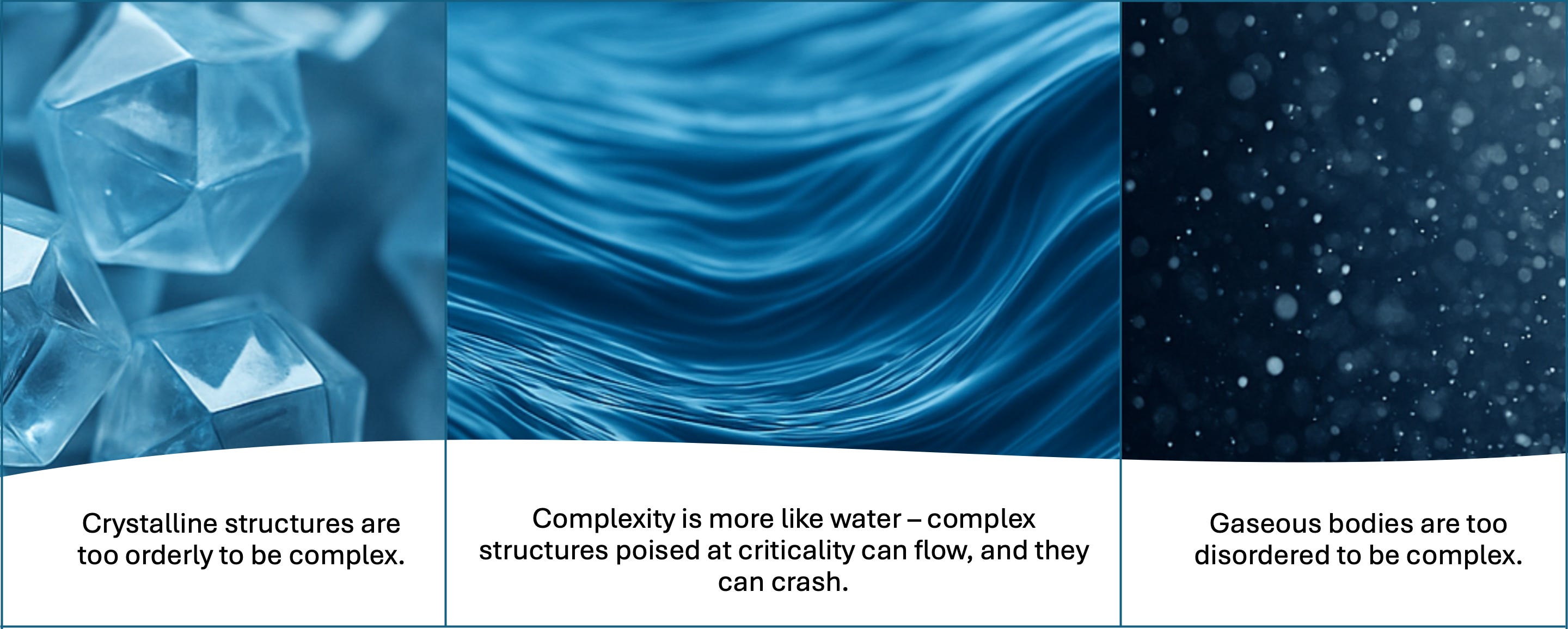
Complexity emerges at the narrow window between order and chaos, where structures can both dissolve and maintain their form. It turns out that when structures are poised at this critical point, their changes, while unpredictable, still follow a predictable pattern. Changes occur in a power-law distribution, which means there are many small changes and occasional catastrophic changes. We cannot predict when the catastrophic changes will happen, but if we plot the changes with hindsight we still end up with a power-law distribution.
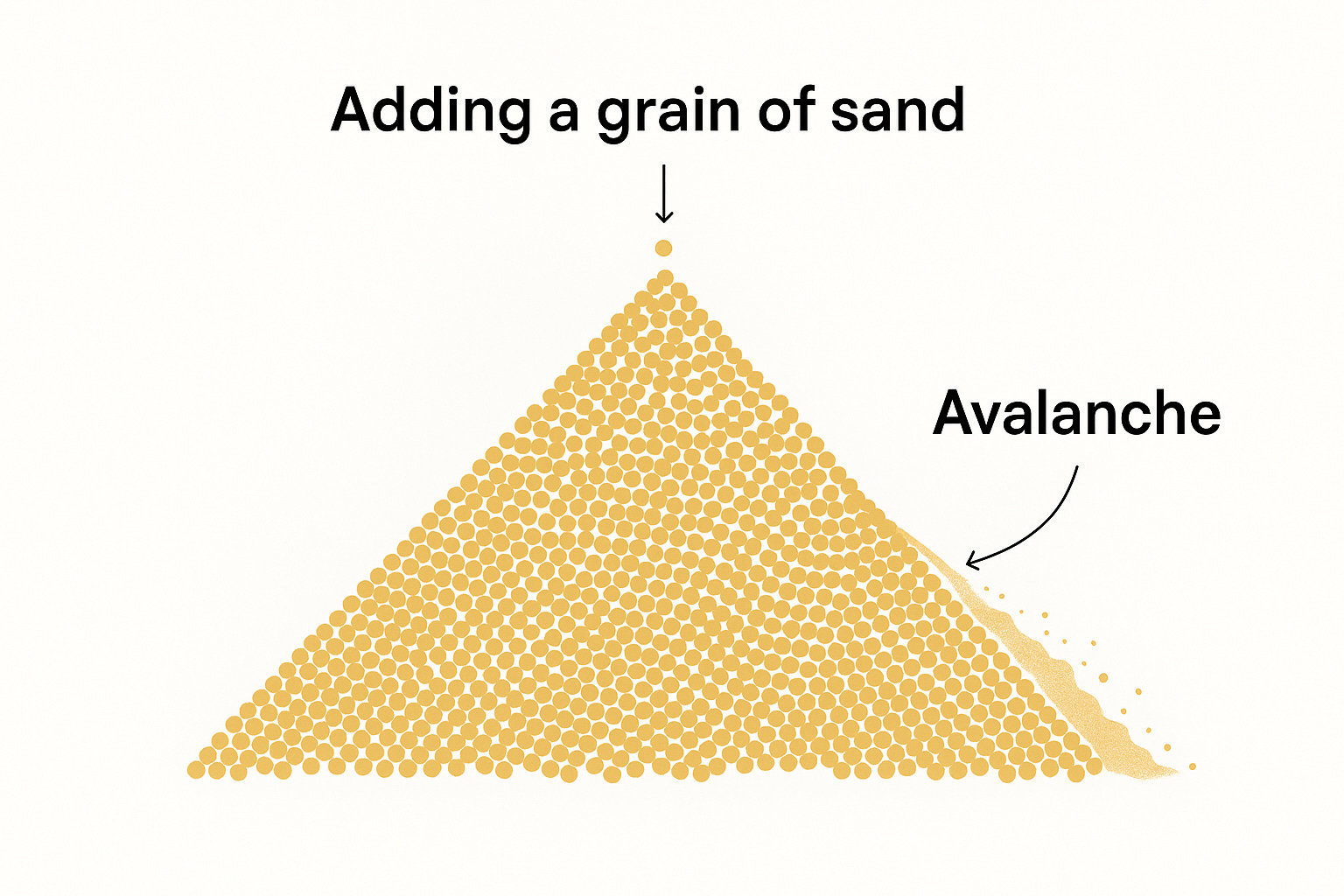
The sand pile model is the most famous way this pattern has been modeled. If you add single grains of sand to a sand pile in succession, you end up with lots of small avalanches and occasional massive avalanches. The size of avalanches forms a power-law distribution.
And finally, Wolf and colleagues, in a 2018 PNAS paper, elucidates the final aspect of the process I want to touch on here—competing interactions. They posit that across scales, both within and outside of biology, competing interactions lead to “frustrated states”, which leads to self-organized criticality, which then leads to increases in complexity:
Competing interactions and frustrated states permeate biology at all organizational levels and are tightly linked to the ubiquitous competition for limiting resources. This perspective extends from the comparatively simple phenomena occurring in glasses to large-scale events of biological evolution, such as major evolutionary transitions. Frustration caused by competing interactions in multidimensional systems could be the general driving force behind the emergence of complexity, within and beyond the domain of biology. (Wolf et al., 2018)
This general process of complexification appears to apply to everything within our universe, and perhaps everything outside it as well. In a previous article I represented this process with the image below, and will again here.

I don’t care to get involved in debates between theists and atheists about the existence of God. The question I ask is different from the one they are debating about. I am not asking whether the God of the Bible or Quran or classical theism exists. I am instead asking whether or not there is anything we can point to in the empirically known universe—the universe as revealed to us by science and our own observations—that is worthy of the name “God”. It would be even better if whatever that is also has some connection to our most ancient traditions. I explain why this process of complexification fits both of these conditions, and is worthy of the name here.
Back to Earth
I introduce that process of complexification early in the essay because I’m going to keep coming back to it. Now to the namesake of this post, Robert Wright’s 2009 book The Evolution of God.
In it, he traces conceptions of God and the gods from hunter-gatherer animism, through chiefdoms like those found on the islands of Hawaii, to more complex civilizations like Egypt and Mesopotamia, then to the emergence of monotheism in Israel, and finally through to Christianity and Islam.
He demonstrates that our conceptions of divinity are malleable enough to adapt when circumstances require them to. In small nomadic bands of hunter-gatherers, the “gods” were not very God-like in the modern sense. Their motivations were conspicuously human: they lied, cheated, and occasionally threw petty temper-tantrums just like humans do. They were not moral gods because they didn’t need to be. They were also not universal. For the hunter-gatherer, it’s not that our tribe didn’t believe in the gods of other tribes—it’s just that those are their gods and not ours. Our gods didn’t need to be the only gods in existence in order for us to believe in and revere them.
The gods of early chiefdoms weren’t much different from that, though they did seem to have a slightly larger moral element. These gods mostly served to maintain social order and justify the rule of the chief:
There are lots of differences among observed chiefdoms, but one thing they share is structural reliance on the supernatural. Their political and religious systems are deeply intertwined; their rulers have a special connection to the divine and put this status to political use. The Polynesian chief, one western scholar wrote, “stands to the people as a god.” (The Evolution of God, pp. 47-48)
When more complex civilizations arose, we began to see the early seeds of monotheism, though these civilizations were far from monotheistic in the modern sense. In Mesopotamia, Marduk was the God, even though there were plenty of other gods in the pantheon:
Marduk’s champions didn’t stop at claiming his supremacy. In a major theological development, the other gods of the pantheon were demoted from being Marduk’s subordinates to being mere aspects of him. Thus Adad—once known as the god of rain—was now “Marduk of rain.” Nabu, the god of accounting, became “Marduk of accounting.” Or, to look at things from Marduk’s perspective, as another text did in addressing Marduk: “Nabu, holder of the tablet stylus, is your skill.” And so on, down the line; Mesopotamia’s major gods got swallowed up by Marduk, one by one.
Scholars disagree over how big a step toward monotheism this was, and over its main cause. (The Evolution of God, p. 88)
Whatever the case, it was clearly a step in the direction of monotheism.
It was also in the more complex civilizations that the gods began taking on a more explicitly moral role. Osiris, in Egypt, was said to weigh your heart upon death, and if your heart weighed less than a feather, you would be granted access to a blissful afterlife. How could you keep your heart light? By acting in accordance with maat, or the principles of good order. This was perhaps the first time we saw afterlife beliefs being used as a moral carrot and stick.
Monotheism began with Judaism, but Judaism did not begin with monotheism. The early parts of the Old Testament still contain remnants of its polytheistic origins, and the transition from polytheism to monolatism (which is where we may believe in many gods but there is only one “true” god) to monotheism is still visible in the text of the Old Testament.
While Judaism made it difficult for monotheism to spread far beyond ethnic boundaries—largely because of difficult conversion criteria like male circumcision—Christianity and Islam allowed for the spread of monotheism to billions. Along with these versions of monotheism came the more explicitly moral God and the carrot-and-stick afterlife beliefs we now associate with organized religion.
Robert Wright clearly documents how conceptions of divinity evolve in response to perceptions of non-zero-sum interactions among disparate peoples. When disparate tribes and chiefdoms were forced to come together into ever-larger civilizations (mostly to protect themselves from roaming bands of raiders), their conceptions of divinity changed to support this new alliance. For example, the pantheon of ancient Mesopotamia eventually settled on Marduk as the supreme God, though many local gods’ existence was still recognized.
Similarly, Wright makes a compelling case that the Roman empire was primed to accept some kind of new religion that better promoted inter-ethnic cooperation, since such cooperation was mutually beneficial given the importance of trade across the empire:
The mass appeal of Marcionite Christianity suggests that if the faith we now know as Christianity—Pauline Christianity—had fallen by the wayside in the second or third century, another version of Christianity probably would have prevailed. Specifically: a version featuring the doctrine of interethnic amity, the doctrine that realized the network externalities offered by the open platform of the Roman Empire. But what if there had been no Jesus—then there couldn’t have been any versions of Christianity to sponsor that doctrine, right? Well, there might not have been anything called Christianity. But even if Jesus had never been born, or had died in obscurity, some other vehicle for the meme of transethnic amity might well have surfaced. (p. 295)
Our conceptions of divinity have never been static. They have been evolving with circumstances for the entirety of recorded history. Is there some reason to believe that our own era is any different? Our circumstances have changed tremendously since the God of Abraham was first conceived, and since he spread across the Roman empire through Christianity. Given the history of God as documented by Wright, maybe we should be expecting a new conception of divinity to gain traction.
Wright makes the case that Christianity—and its message of multi-ethnic harmony and salvation—spread largely as a result of the non-zero-sum dynamics created by inter-ethnic trade throughout the Roman empire. Today we have a new set of non-zero-sum dynamics. Below I want to explore some of the conditions that might promote a new conception of divinity.
The Games of Modernity
There are a few non-zero-sum games and two zero-sum games I will briefly discuss that are relevant to modern conceptions of divinity. The non-zero-sum games are:
New human-created existential threats. Nuclear war, biological weapons like super-viruses, runaway artificial intelligence, and nano-technology are just some of the conceivable existential threats brought about by the technological revolution we’re currently experiencing.3
Global economic freedom and trade. We have gotten very, very rich in the last century. The extreme poverty rate worldwide has plummeted while the wealthier countries have continued to become more wealthy. At least in absolute terms, everyone is winning as a result of global trade and the expansion of free markets.
Science. As far as I’m concerned, the scientific enterprise is the Western world’s greatest accomplishment, and also represents a global non-zero-sum game because everyone benefits from the fruits of scientific labor (with an important exception that I’ll explore in a section below).4
Those are the non-zero-sum games. There are two zero-sum games that I also think are potentially relevant to our conceptions of divinity.
Belief. We form moral and political tribes around belief systems. Belief systems are almost always mutually exclusive. If you believe that Islam is true, you cannot simultaneously believe that Judaism or Christianity is true. An atheist cannot simultaneously be a believer. Democrats and Republicans usually have mutually exclusive factual beliefs about the world, and so on. Belief systems are a zero-sum game when it comes to recruiting believers.
Inequality. Global economic freedom and trade has made us more wealthy in absolute terms, but it has also exacerbated relative economic differences between people within large nations. Even if the poor are better off in absolute terms than they were 50 years ago, relative economic deprivation still leads to a host of negative consequences.
I bring these up because I think these are some of the most relevant non-zero-sum and zero-sum games of our time, and that any conception of divinity must ultimately grapple with them in one way or another. It would take a book to explore them all in detail, so I can’t do that here. Instead I’ll focus on one that can be meaningfully addressed in this essay: the zero-sum game of belief and how it relates to the non-zero-sum game of science.
Science vs. Belief
Science relies on fluidity of belief. Beliefs must not be sacred because—at least in principle—all beliefs about the empirical world are subject to change as new evidence is gathered. In reality, of course, some beliefs are so well-supported that we can safely hang our hat on them: general relativity, Darwinian evolution, and plate tectonics come to mind.
All mainstream versions of the Abrahamic religions actively discourage fluidity of belief. They have to, since their moral authority rests on empirical claims that are implausible or highly susceptible to falsification. At least in the case of mainstream Christianity (which is what I know best since I grew up as part of it and surrounded by it), many Christian denominations really believe that the Old Testament is a historically accurate document, that Jesus performed miracles and was resurrected, and that there is a heaven and hell that our eternal soul can be sent to when we die.
Those beliefs—or some combination of them—are central to mainstream Christianity, whether protestant, Catholic, or Orthodox. Even if some church-goers believe otherwise, openly acknowledging that you don’t know whether Jesus was literally resurrected at church while surrounded by your fellow believers would make for a very awkward experience.
Those who have looked into scholarship on early Christianity will know that the New Testament gospels were written long after Jesus was dead by people who never knew him. The authors are anonymous (they are not Matthew, Mark, Luke, or John), and their tales reflect an oral tradition as well as an unknown written source referred to as the “Q source” in academic literature, though Mark was not influenced by the Q source. Each book makes some changes to deal with known theological problems with the initial story.
For example, the earliest written gospel Mark does not state that Jesus was born in Bethlehem, referring to him only as Jesus of Nazareth. Later gospels Matthew and Luke correct this oversight by including the story of Jesus’ birth in Bethlehem, in line with the Old Testament prophecy from the book of Micah. The problem is that Matthew and Luke’s stories are inconsistent with each other. In Matthew, the narrative reads as though Bethlehem is the family’s hometown. In Luke, a Roman census requires Joseph to travel from Nazareth to Bethlehem, where Jesus is born. The prophecy needed Jesus to be born in Bethlehem, but the authors don’t seem to agree on how that came to pass.
The most plausible explanation is that Mark didn’t include any mention of Bethlehem because that particular connection to Old Testament prophecy hadn’t been well-established yet. Later, once it had been firmly decided that Jesus’ birth had been prophesied by Micah, Matthew and Luke made up different stories to accommodate it.
And there are some big problems with both of these stories. Just a couple: In Matthew, it’s highly implausible that Herod would be able to kill every male child under 2 years old in Bethlehem without any other historical mention of it. Somebody would have mentioned it, especially the historian Josephus, who wasn’t a fan of Herod anyways. In Luke, it makes no sense that the family would have to return to Bethlehem for a census just because Joseph’s ancestor from a thousand years ago was King David. The logistics of such a requirement in the ancient world are laughable.5
All of this makes the more fantastical claims about miracles even less credible than they otherwise would be. The gospels just aren’t credible historical documents, except insofar as they document the beliefs of the early followers of Jesus.
The implausibility of Abrahamic religions appears to be the main reason their influence is shrinking in the Western world. From 2010-2020, the percentage of people identifying as Christians in Europe fell from 75% to 67%. The 1% increase in Muslim identification didn’t come close to making up for it. Changes within the United States were just as dramatic, with 78% identification in 2007 to 62% identification in 2023-24. Of religiously unaffiliated people in America, 60% said that doubts about religious teachings were extremely/very important to their lack of religious affiliation.
The trend will continue for the foreseeable future, if only because Christians in the West are older than non-Christians, and will die sooner. Even if nobody else leaves the faith, the proportion of Christians will continue to go down for that reason alone.
There is a zero-sum game being played over belief. One set of players in this game are those institutions and people who attempt to abide by what Jonathan Rauch referred to as The Constitution of Knowledge. Rauch also refers to them with the more self-congratulatory label of the reality-based community. At least in principle, a reality-based community plays by certain rules: no individual or institution may claim final authority. All claims are subjected to criticism, tested against evidence, and only provisionally accepted when they survive that process. Science is the clearest example of such a community, but at their best, journalism6, the justice system, and other institutions of organized fact-finding operate according to similar principles.
Playing by these rules, it is clear that the core beliefs of traditional religions don’t survive the process. The Bible (and some of its interpreters) claim final authority, but when tested against evidence, far too many claims just don’t add up. One response from organized religion is to encourage its adherents to simply avoid reality. I’ve heard it from Catholic talk radio, Southern Baptist preachers, and Jehovah’s witnesses—all have encouraged their adherents to avoid reading, watching, or listening to anything that could raise doubts about their faith.
While science and religion need not be at odds, it’s clear that the scientific process—and the Constitution of Knowledge more generally—is at odds with mainstream traditional religion, which too often relies on maintaining implausible beliefs in the face of constant evidence against them. This is a zero-sum game, not only for the beliefs themselves, but for the process by which those beliefs are maintained or updated.
Do we rely on the final authority of a book, a man (like the Pope), or an institution? Or do we rely on the always-incomplete and ongoing process described by Rauch?
If we choose the latter, does that necessarily lead to Godlessness? Well, no. In fact, Robert Wright, a bona fide participator in the reality-based community, put forward an interesting understanding of God in his 2000 book Nonzero that doesn’t require us to avoid reality, or maintain implausible beliefs in the face of contradictory evidence.
Robert Wright’s Logos
Nonzero’s subtitle is “The Logic of Human Destiny”, and that is what Wright demonstrates in the book. The evolution of human social structure has not been random. The movement from small nomadic groups to tribes, chiefdoms, city-states, empires, nations, and global markets was not accidental or random. It was inevitable—or if not inevitable, at least highly probable.
Wright contends that the scope of non-zero-sum interactions7 has continued to increase over the course of human history because those groups of humans which can take advantage of such interactions tend to outcompete those groups of humans which fail to do so. For most of human history, to “outcompete” another group usually meant to conquer and/or enslave them, though that has changed more recently.
Interestingly, Wright explicitly associates non-zero-sumness with our definition of complexity, as a simultaneous increase in both differentiation and integration:
To say that reaping non-zero-sum benefits elevates social complexity borders on the redundant. The successful playing of a non-zero-sum game typically amounts to a growth of social complexity. The players must coordinate their behavior, so people who might otherwise be off in their own orbits come together and form a single solar system, a larger synchronized whole. And typically there is division of labor within the whole. (Some people make the nets, some people man the nets, some people chase the rabbits.) One minute you’re a bunch of independent foragers, and the next minute you’re a single, integrated rabbit-catching team, differentiated yet united. Complex coherence has materialized. (p. 21)
As non-zero-sumness increases, groups become more differentiated and integrated. This means that the process Wright describes in his book is just one manifestation of the more general process of complexification described at the beginning of this article (and in more detail here).
And, like myself, Wright seems compelled to consider the idea that this process is… God. Like myself, he definitely doesn’t mean the God of classical theism, which he also finds to be hopelessly implausible:
The kind of God that is hardest to find evidence of is the kind most people seem to believe in: a God that is infinitely powerful and infinitely good. (p. 319)
Rather, the question he asks is similar to the one I posed earlier. We do not ask whether the God of classical theism exists, but whether there is anything in the empirical universe worthy of the name:
The point here is just to ask: Are there signs of any divinely imparted meaning in the evidence immediately before us: the history of life on earth? (p. 320)
He tentatively answers in the affirmative:
That biological evolution has an arrow—the invention of more structurally and informationally complex forms of life—and that this arrow points toward meaning, isn’t, of course, proof of the existence of God. But it’s more suggestive of divinity than an alternative world would be: a world in which evolution had no direction, or a world with directional evolution but no consciousness. (p. 323)
Wright ends the book by identifying this process with the Logos, a term used in the book of John but mistranslated as “the Word”, and often misunderstood by Christians as referring to the Bible. Logos, in this context, is more accurately understood as “the point” or “the plan”, though it is a little more subtle than that. As Wright states:
Logos also means “argument,” and it is tempting to view biological and cultural evolution somewhat as Hegel viewed human history—as a very long argument. Competing ideas about how to organize organic entities clashed. And non-zero-sumness won in the end. (p. 333)
Logos is more like the logic of history. A logic that is embedded within everything at all times and places. The Logos, as understood by pre-Socratic philosopher Heraclitus, has been described as such:
This Logos is not merely the process of change; it is the orderly process of change. The Everlasting Fire is kindled in measure and quenched in measure, and it is this Measure, by which the process and its material are ruled, that makes our world intelligible. This is the true One in Heraclitus’ system; it is the only thing that persists in change, and it is everywhere . . . The Logos is not an arbitrary creator, but a Law, the source of all that is intelligible. (Freeman, 1946 p. 116)
Graham (1997) also described the Logos as the universal pattern of transformation:
If there is an orderly world—and that there is is a fact—there must be some universal pattern of transformation, some law of change . . . The world is, in its broad outlines, stable, though it is built upon a process of transformations. There must then be a constancy in the pattern of transformations… [Heraclitus] needs a term to express this law of transformations. He hits on one delightful in its ambiguity, but which expresses both structural order and mathematical ratio: Logos. Everything happens in accordance with Logos. (p. 36)
Wright doesn’t mention Heraclitus, but it’s clear to me that this is the sense in which he uses the word Logos. Wright’s Logos is the pattern of transformation, the law of change, that underlies the directionality of biological and cultural evolution towards ever-greater complexity.
What’s interesting is that Robert Wright’s God is explicitly identified as a God of evolution—a God whose action is knowable to us through the patterns manifest in biological and cultural evolution. It would be some kind of irony if Darwinian evolution—the theory that had the most devastating effect on belief in the God of classical theism—would also be the theory most intimately involved in the new, scientifically influenced conception of God.
I have some objections to Wright’s depiction of the process, particularly his characterization of it as representing moral progress, or as the discovery of moral truths. I think that’s wrong, and even dangerous, for a number of reasons, but I’ll need to save those objections for another post. What he gets right is more important than what he gets wrong for our purposes here.
There is another author who published a book the year before Nonzero, who also used the word Logos to identify a pattern of transformation. While Wright focused on biological and cultural evolution, this author was more focused on the transformations of individuals. Despite their very different styles and intellectual backgrounds, let’s try to see if they were, in fact, identifying the same pattern from different perspectives.
Jordan Peterson’s Logos
Jordan Peterson is an interesting character. He is widely loved and widely hated. He’s about as polarizing as Donald Trump. He even polarized me, since I love the guy and am eternally grateful for the effect of his class lectures and his first book Maps of Meaning, while also being constantly annoyed by his capacity to say dumb stuff on Twitter8.
The problem with this type of polarization is that people either tend to think that everything which comes out of Jordan Peterson’s mouth is a golden nugget or else dismiss anything the man says out of pure spite. This matters because Peterson has had some brilliant and important ideas, the transmission of which will be unfortunately hindered by his reputation. In his first and most important book Maps of Meaning, Peterson put forward a conception of divinity that is almost eerily concordant with everything discussed above.
In 1999, it’s very unlikely that Jordan Peterson knew who Robert Wright was, or Lee Smolin, or Per Bak, or any of the influences I’ve mentioned above. They were all around and writing at the time, but weren’t nearly as well-known as they are now. If Jordan did know about them, he never mentioned them. That’s what makes the parallels I’m about to discuss so interesting. They seem to represent a true convergence, despite the fact that Jordan’s thinking is occurring within a very different tradition than any of those mentioned above.
Despite his more recent turn towards Christian apologetics, the conception of divinity put forward in Maps of Meaning is not very concordant with mainstream Christianity, or any other Abrahamic faith. That said, it is also not dismissive of them, because in each case it shows how the stories which have captivated millions or billions of people follow a similar pattern.
That pattern is the meta-mythology, which occurs at the border between order and chaos, involves competing interactions, a descent into chaos, and a re-emergence into a higher form of order.

That pattern just is the process of complexification described in the opening of this post. One does not need to squint their eyes to see it. The meta-mythology must begin with some kind of competing interaction, often between beliefs, or between the perceptions of the individual and the beliefs of the group, or (in mythological terms) between the hero and the dragon, Marduk and Tiamat, Osiris and Set, Moses and the Pharaoh, Christ and Satan, etc.
That competing interaction can be understood as creating a “frustrated state”, which then leads to the avalanche associated with self-organized criticality9, which is equivalent to the descent into chaos depicted by the meta-mythology. Peterson doesn’t use the terms “frustrated state” or “self-organized criticality”, of course, but the overlap between the pattern he describes and the pattern described within the complexity literature is clear enough that I can use those terms with no loss of meaning.
Peterson’s book largely focuses on the application of this pattern to the individual. For example, he spends much of chapter 2 discussing the research on the “orienting reflex” done by Russian psychologists. Peterson regards the orienting reflex as the basic form of our response to novelty—the unexpected, unwanted, and/or inconceivable.
Briefly, we always have a basic “model” of the world which is necessarily simplified and incomplete. Peterson depicts it as a story. This story is not about the objective world, but only the world as it is relevant to our goals and desires. As long as we are moving towards the goal, our story remains undisturbed. This is normal life.
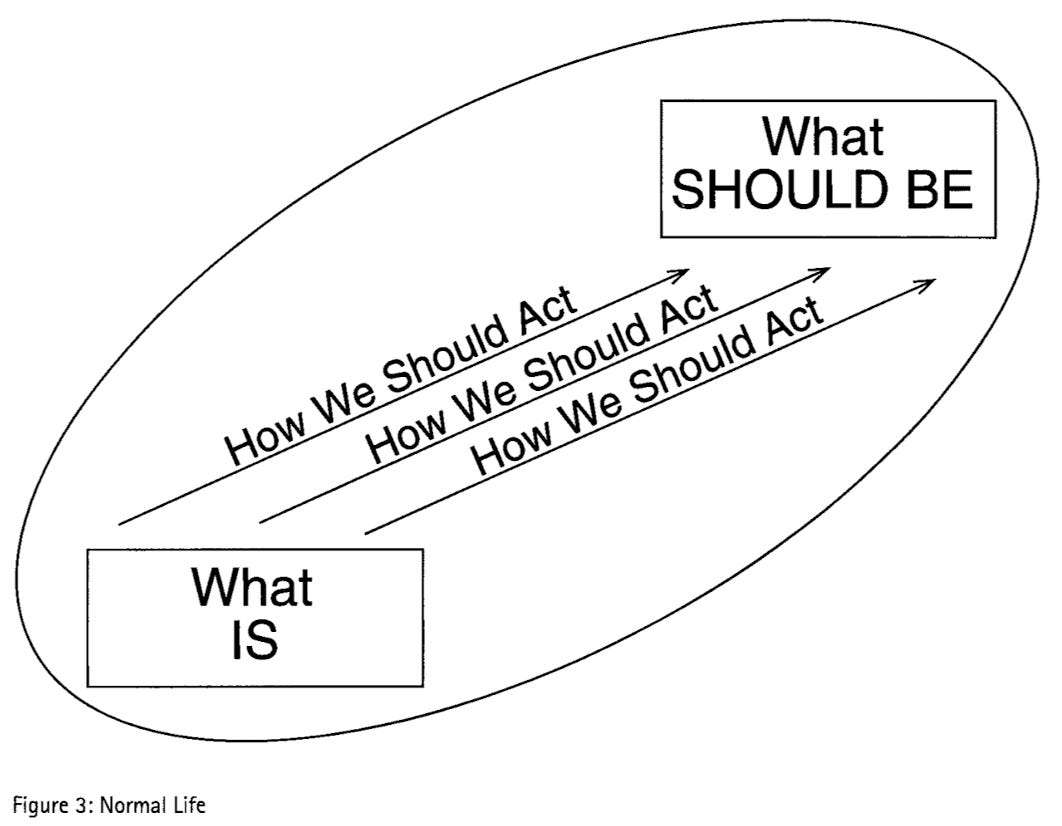
The comparison of “What Is” to “What Should Be” is what provides events with their emotional salience. Events which move us from what is to what should be are experienced neutrally or positively. Events which disrupt our movement towards the desired future are typically accompanied by negative emotion.
When something unexpected or undesirable occurs, the story we inhabit is disrupted. This disruption can be minor or much more serious, depending on the level of analysis where it occurs. If we open our cabinet to find that we ran out of pancake mix in the morning, that’s a disruption to the desired state of eating pancakes, but it’s not that big of a deal. We can make eggs and bacon instead.
If, however, we arrive at work to find that we are being fired from our job, that’s a much bigger disruption. The desired state may have been a promotion, early retirement, or whatever, but now that desired state is no longer an option. Now we must change our story. This kind of disruption is typically accompanied by a wave of powerful negative emotion:
You are shocked beyond belief, paralyzed into immobility. Your vision of the future with this company vanishes, replaced by apprehensions of unemployment, social disgrace and failure. You find it difficult to breathe. You flush and perspire profusely; your face is a mask of barely suppressed horror. You cannot believe that your boss is such a bitch. “You have been with us for five years,” she continues, “and it is obvious that your performance is not likely to improve. You are definitely not suited for this sort of career, and you are interfering with the progress of the many competent others around you. In consequence, we have decided to terminate your contract with us, effective immediately. If I were you, I would take a good look at myself.”
You have just received unexpected information, but of a different order of magnitude than the petty anomalies, irritations, threats and frustrations that disturbed your equilibrium in the morning. You have just been presented with incontrovertible evidence that your characterizations of the present and of the ideal future are seriously, perhaps irreparably, flawed. Your presumptions about the nature of the world are in error. The world you know has just crumbled around you. Nothing is what it seemed; everything is unexpected and new again. You leave the office in shock. In the hallway, other employees avert their gaze from you, in embarrassment. Why did you not see this coming? How could you have been so mistaken in your judgment? (MoM, p. 30)
In response, we cannot simply re-adopt our old story after making a different breakfast food. We must re-assess the story itself. We must engage in what Peterson calls “revolutionary adaptation”.
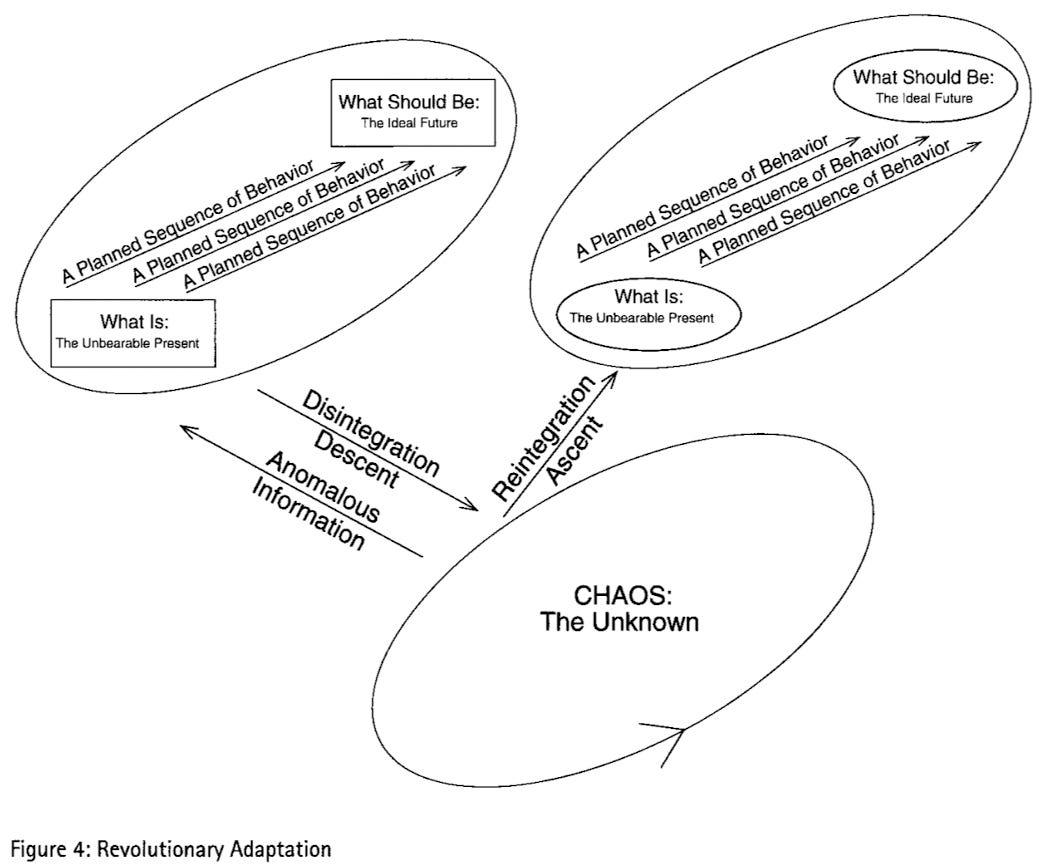
In response to the anomalous information of being fired, we descend into emotional and behavioral “chaos”. In other words, we’re kind of freaking out because we don’t know what went wrong, don’t know what to do about it, and a lot of stuff we cared about is gone. That’s chaos. We must adopt a new picture of “What Is” (i.e., what kind of person are we? what kinds of goals are available to us?) and a new picture of “What Should Be”, whether that’s looking for a new career path or something else.
In response to an anomaly of this kind, there will be competing interactions between all of the different interpretations of it: Was it our fault or were we treated unfairly? Are we competent or incompetent? Should we make a lateral move, find a new career, or go jump off a bridge? These competing interactions create massive amounts of psychological entropy, which can be understood as a descent into chaos.
While I can’t do a 500 page book justice here, Peterson shows that this pattern of behavior is an extended form of the orienting response studied by the Russian psychologists and is reflected in the structure of the brain, especially in its hemispheric organization. In terms of evolutionary psychology, Peterson is claiming that humans have psychological adaptations for dealing with the unknown, and that our response to anomalous information follows a general pattern that is also reflected in our neurobiology. He then spends a large portion of the book showing how this pattern manifests in ritual, story, myth, religion, philosophy, and so on.
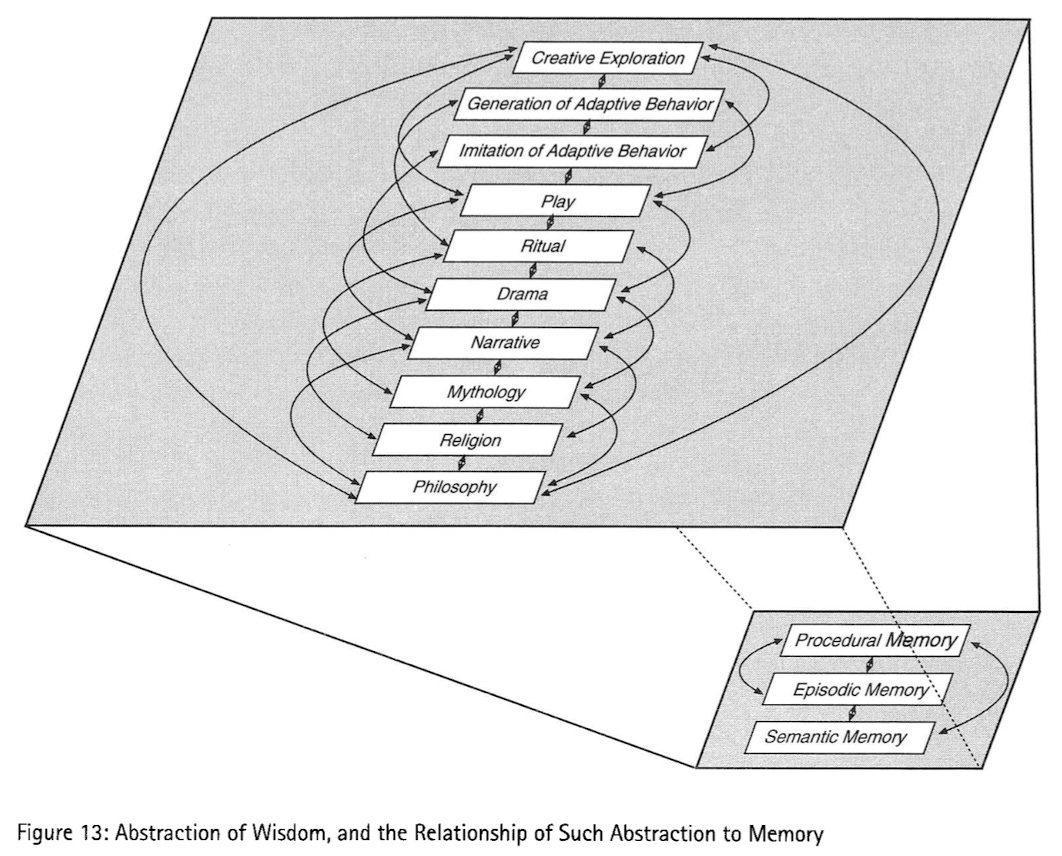
He argues that we have always observed people who behave admirably. Admirable behavior often involves the confrontation, exploration, and resolution of novelty. Having imitated these admirable people, we attempt to depict their patterns of behavior in ritual, story, and myth. That is why our great stories seem to adopt such similar patterns, which Joseph Campbell popularized in The Hero With A Thousand Faces as the hero’s journey.
Wouldn’t it be interesting if the pattern underlying the ongoing creation and complexification of everything is the same as the pattern which permeates these ancient hero mythologies? Wouldn’t it be interesting if—at least implicitly—our ancestors recognized that pattern and simply understood it as “God”?
That does seem to be the implication of Peterson’s thesis in Maps of Meaning. The stories of Marduk, Horus, the Buddha, and Jesus Christ all follow this basic pattern.

If Peterson is right, then our ancestors have been transmitting that pattern through imitation, ritual, and myth for a very long time.
Might we now be able to understand this pattern or process scientifically? Wright identified a process of complexification in biological and cultural evolution. Wolf and colleagues (along with many other scientists) identified the same pattern as characterizing complexification both within and outside of biology. Peterson and many other psychologists (see literature on positive disintegration and post-traumatic growth, for example) identify the same pattern in terms of individual development. Peterson, Joseph Campbell, and Carl Jung are all known for having identified the same pattern within mythology, narrative, and the human imagination more generally.
I’m not as tentative about it as Robert Wright has been. The pattern which characterizes this general process of complexification is real, consequential, and manifests at every level of analysis we can observe. It really is turtles all the way down, except the turtles look something like this:
competing interactions → frustrated/unstable state → criticality/chaos → reorganization → emergence of a new, more complex state
It’s not that this pattern always occurs everywhere at all times. It’s that any time complexification, or the emergence of novelty, does occur, it follows this basic pattern, which means that everything new emerges through this process. As best I can tell (and as best Wolf et al. could tell in 2018), this process characterizes complexification at every level of analysis.
As I reviewed in more detail elsewhere, biologists, neuroscientists, and cognitive scientists have all conducted research indicating that our participation in this process of complexification, which emerges at the border between order and chaos, is biologically optimal (see, e.g., the computational benefits of systems poised at criticality; brain functioning at criticality; consciousness at criticality, etc.). I feel safe in saying that our participation in this process is good, if anything can be called good in this world.
If I can’t call that God, then I don’t know what could be called God.
In conclusion, I see the evolution of God in terms of a kind of Hegelian synthesis (not that I’ve ever actually read Hegel). There is the thesis of classical theism, the antithesis of new atheism, and the synthesis which shows that, yes, while the scientific enterprise has undermined the God of classical theism, it has revealed an evolutionary God that is still connected to our ancient theological traditions, even if not in the way that most people expected.
And so, everyone involved in this debate is wrong and must give something up. The new atheist types have to give up their smug dismissal of religion as just a bunch of silly beliefs. To the contrary, although modern religion may rely on some silly beliefs, the function of religion is far more important than to be a retainer of false beliefs.
But the religious people have to admit that the smug atheists were right that their beliefs are, in fact, silly. And I don’t think that’s going to be an easy pill to swallow.
In the end, my point is really just that…
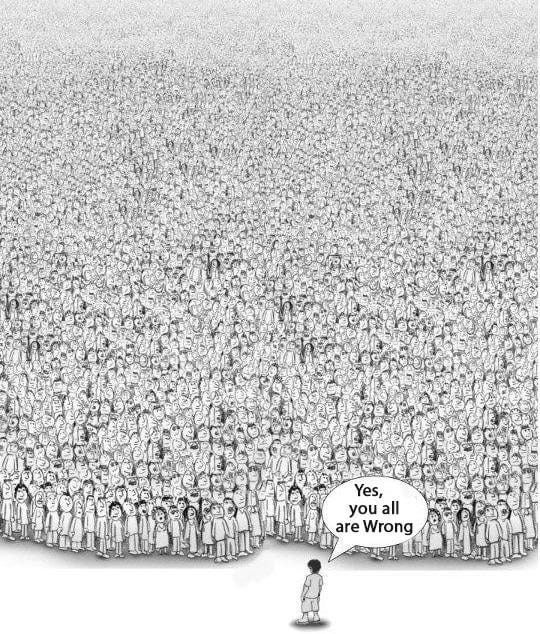
But you don’t have to be, as long as you agree with me.
Calling the universe “flat” means that the universe obeys Euclidean geometry, not that it’s in the shape of a flat disk or something.
ChatGPT wrote that sentence, since I’m a neanderthal.
There are undoubtedly a number of existential threats that we currently can’t conceive of because the relevant technology hasn’t been invented yet. Navigating this period of unprecedented technological improvement without producing some civilization-ending catastrophe—or, alternatively, adopting some techno-authoritarian superstate to prevent such a catastrophe—ought to be our number one policy priority, but in reality it’s barely an afterthought. This is perhaps the most important global non-zero-sum game in human history.
Of course, the scientific revolution can’t be fully separated from the technological revolution that is producing a bunch of new existential threats. But it’s still worth it, and I don’t think the tradeoff is even close. If our goal is for life to continue on for as long as possible, then a subsidiary goal must be for life to eventually colonize the galaxy. That might be impossible, but if there’s even the slightest chance for it to happen, new scientific discoveries will be needed. For that reason and others, science is a non-zero-sum game that everyone can potentially benefit from.
Another change: Mark says that Jesus could not do “mighty works” in Nazareth, while the later gospel Matthew changed this so that Jesus chose not to perform miracles there because of their unbelief. Luke omitted the line entirely, instead including a story about how the Nazarene crowd tried to throw Jesus off a cliff. Mark’s version is more theologically risky—to say that God in the flesh was unable to do something invites difficult questions. The later gospels of Matthew and Luke alleviate such theological worries.
Unfortunately, this one often seems to go off the rails. There is good journalism out there and a community of journalists dedicated to truth-seeking, but there are other incentives that tend to pull journalists away from reality.
One might wonder why we would use this clunky phrase instead of just using the word “cooperation”. Wright explains that:
… perhaps the ultimate rationale for using the word “non-zero-sum” is that, no matter how far you stretch the word “cooperation”—even if you’re willing to apply it to genes and to the relationship between me and Honda’s employees—the two words still are not comparable. A non-zero-sum relationship is not a relationship in which cooperation is necessarily taking place. It is (usually) a relationship in which, if cooperation did take place, it would benefit both parties. Whether the cooperation does take place—whether the parties realize positive sums—is another matter. And, aside from “non-zero-sum,” I can’t think of a word that captures this relationship. To call it a relationship in which “self-interest rationally pursued could lead to cooperation” just isn’t very economical. Even a relationship “conducive to cooperation” isn’t very economical, and is vague, even misleading, to boot. All of which brings us back to “non-zero-sumness.” (Nonzero, pp. 338-339)
I am using the language of Wolf et al., 2018 to make the overlap as obvious as possible.
A great read, thank you, Brett. I don't know if you've encountered Tim Freke recently, but he's come away with a very, very similar conclusion to you, but from a slightly different direction. He's a great dude. https://newsletter.theleading-edge.org/p/at-the-leading-edge-of-a-new-worldview?r=2613wg
"...one could see atheism (in the modern sense) as the transition to a new, and more exciting development of God. If we look back at history, we will see that when people were called 'atheists', this usually usually marked a religious transition. One of those quantum leaps to an entirely new era of religiousity and spirituality. Thus, in the early stages of their history, Jews, Christians, and Muslims were all called atheists by their pagan contemporaries..."
- Karen Armstrong, 'The Future of God'