

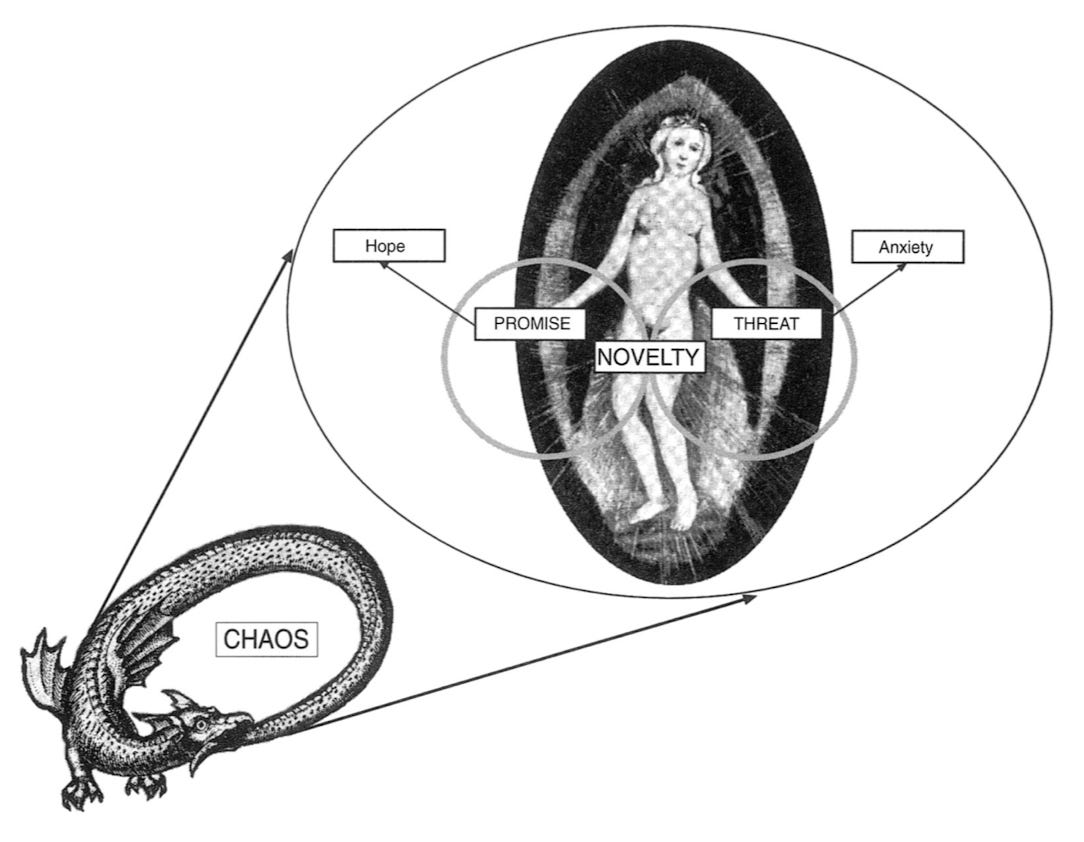
Three options:
Anxiety: AI is the most dire existential threat in the history of mankind. If anyone builds it, everyone dies.
Hope: AI is the source of our salvation, and building it will lead to a post-scarcity world (or, for some nihilistic weirdos, a post-human world).
Denial1: AI is an over-hyped technology that, while clearly important, represents nothing out of the ordinary in terms of technological progress—doomsday scenarios and post-scarcity promises are both overblown.
There are obviously positions that exist between these, but those seem to be the basic options concerning our attitudes towards artificial intelligence.
As someone who is not an expert in machine learning, I don’t know which of these will be closest to the truth. I see the threat and the promise, so I’m both anxious and hopeful. I won’t pretend to have answers on what we should do about it.
This article is not about deciding between these positions, nor will I lecture you about AI safety or over-regulation. This post is instead going to connect the AI revolution to a framework that may shed some light on why there are so many contradictory positions on AI, even from seemingly well-informed people. That framework mostly comes from Jordan Peterson’s first book Maps of Meaning (MoM), though it was derived from the work of Carl Jung, Erich Neumann, Mircea Eliade, and others who documented the symbolism of the Great Mother archetype.
And while I don’t have any particular suggestions about AI regulation, I do think we can derive some general principles from this framework which may help us lean towards paradise and away from doom.
We now have plenty of examples of people working on AI who say it’s going to kill us all.
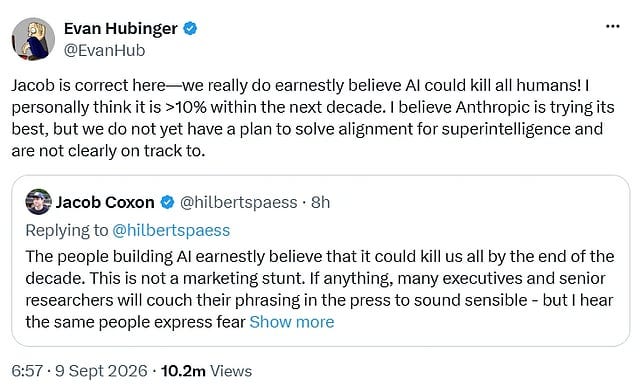
What should we do with that information? Ignoring it is obviously a bad idea, but the range of possibilities about what to do is vast. Shall we give the AI companies a stern scolding on Twitter or should we organize a Butlerian Jihad style ban on LLMs?
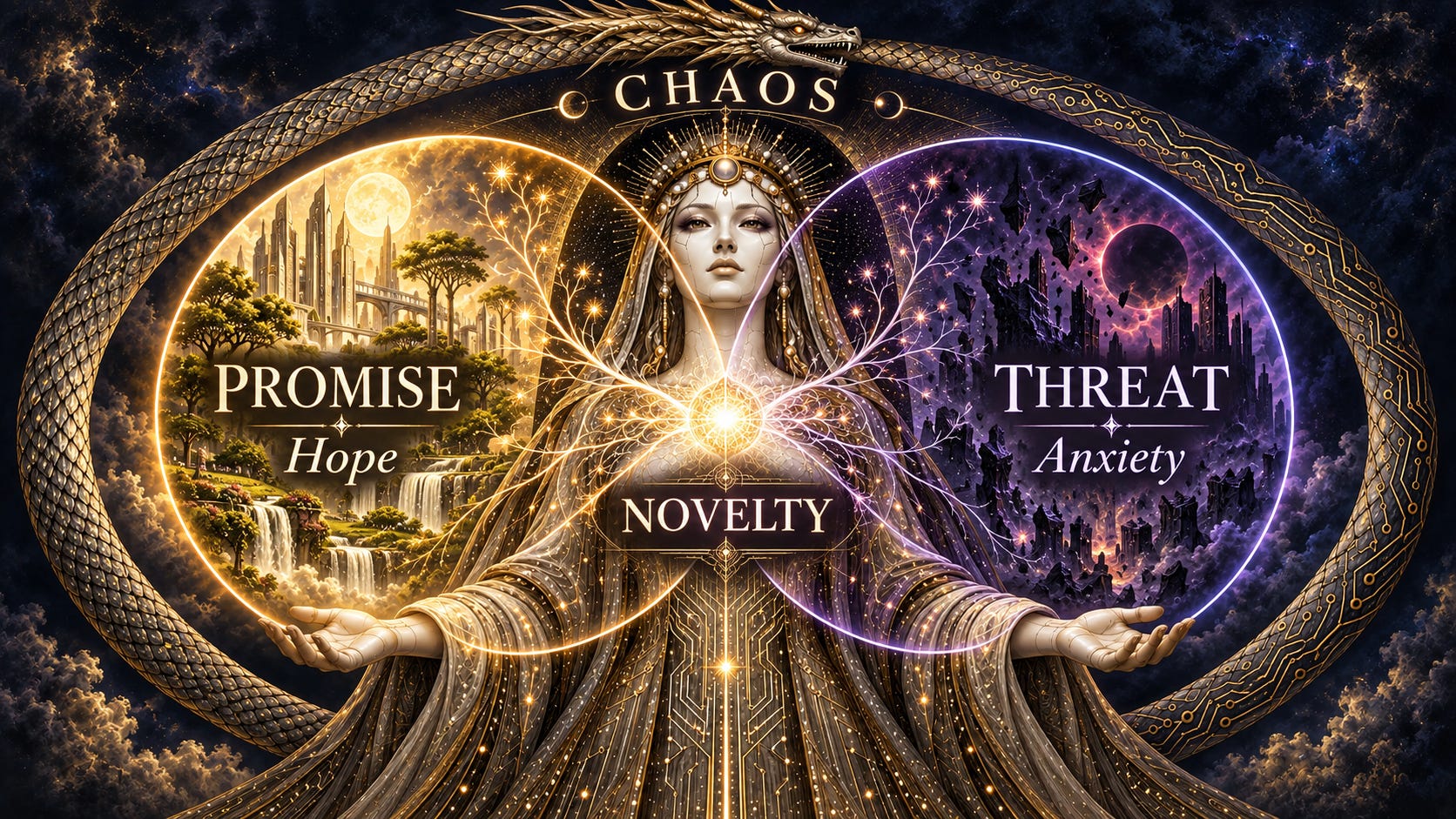
What’s clear to me is that AI is pregnant with potential. Whatever kind of future it gives birth to will be determined by our responses to it here and now, and whether that future is destructive or generative has yet to be determined.
I can use those birth-giving metaphors naturally because of the intuitive connection between novelty and child-birth. As was pointed out by Lakoff and Johnson in Metaphors We Live By, our everyday language is permeated by metaphors we hardly notice. A couple examples are below:
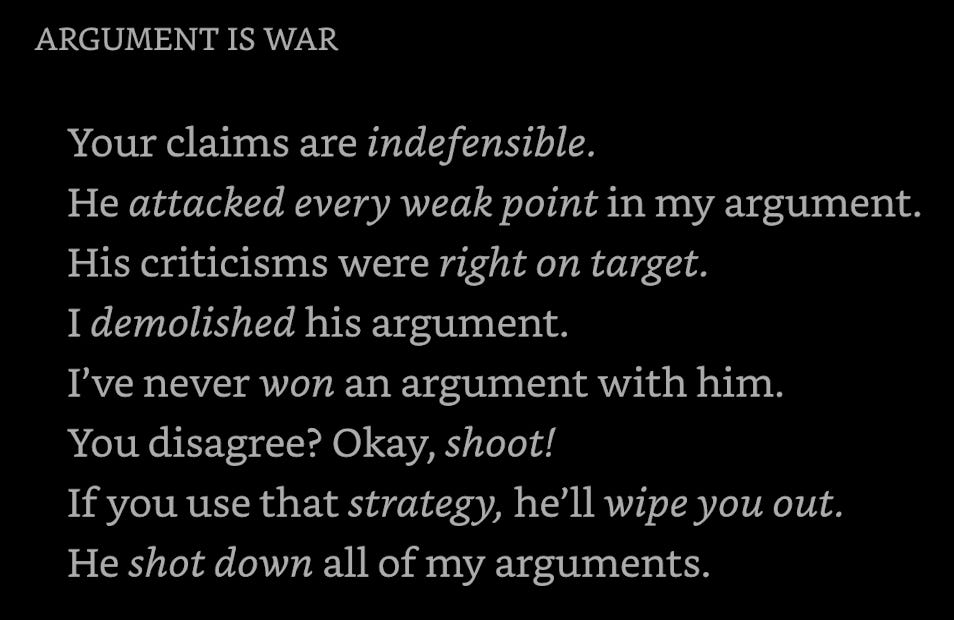
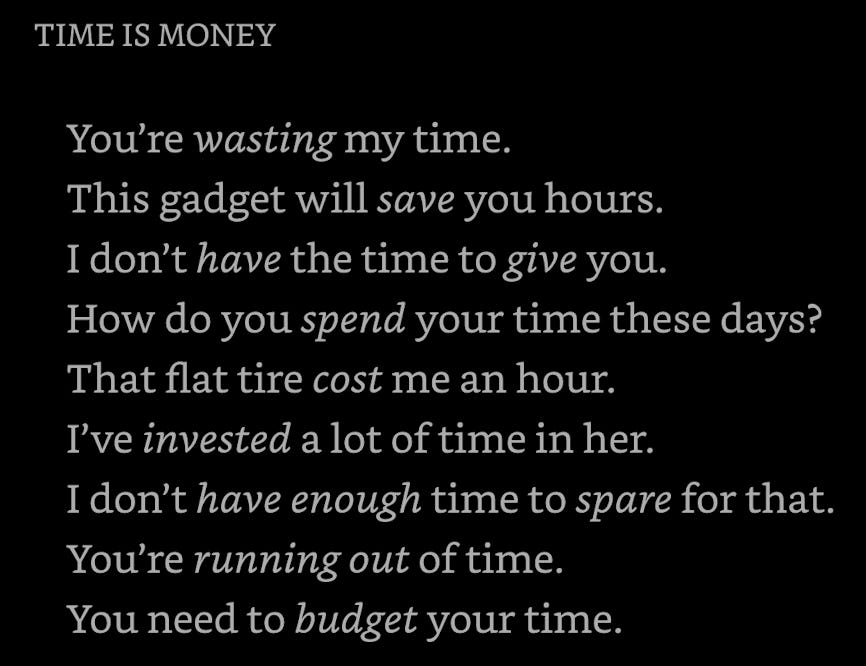
Argument is war and time is money are metaphors, but we don’t really think about them as metaphors. They’re just part of our language. Similarly, we can understand that AI is pregnant with possibility and may give birth to some new kind of society because we are familiar with metaphors where the emergence of novelty is childbirth.
Given that connection, hopefully it will be easier to understand why the unknown, chaos, novelty, and so on are all archetypally feminine.
The unknown—as it can be encountered—is female, with paradoxical qualities. The Great and Terrible Mother of All Things promises endlessly; she also threatens, absolutely. The outcome of an encounter with the unknown—which constitutes the necessary precondition for the generation of new information (for generation of the “cosmos” and of the experiencing subject)—cannot be specified beforehand; something new might benefit, or destroy. Femininity shares emotional valence with novelty and threat[…] because of the union that exists within experience between creation of one thing, and destruction and transformation of another. (MoM, p. 157)
Real novelty is always both promising and threatening, potentially creative and potentially destructive. If something can be classified resolutely as either promising or threatening, then it is not truly novel2. If a thing’s valence (positive or negative) is already known, then our physiological reaction to it will be different from our reaction to those novel events which cannot yet be categorized as positive or negative.
The Great Mother—who gives birth to all that is new—is the archetype of novelty, and therefore has a promising and threatening aspect. I think that much is easy enough to understand. We can see why novelty is pregnant with potential and gives birth to the future, and can therefore understand why novelty might be associated with the feminine, and why it may be understood as a metaphorical mother.
Where Carl Jung, Erich Neumann, Joseph Campbell, Jordan Peterson, and everyone else who has made similar connections tend to lose people is in demonstrating how this relationship is represented in our collective imagination through art, literature, and other forms of media.
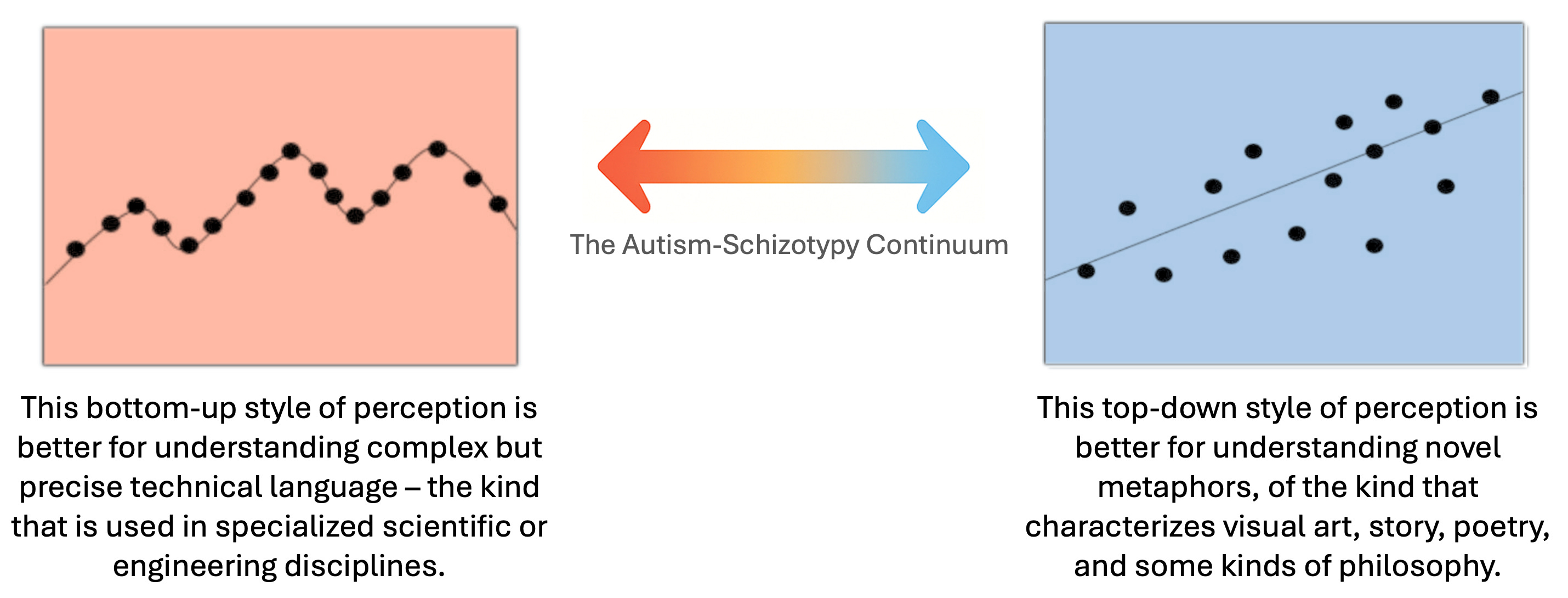
This is because the patterns discussed below are noisy rather than precise. Any single example can be dismissed as coincidence or confirmation bias3. The pattern only becomes clear if seen as a whole. Of course, the skeptics will claim that any perception of this supposed pattern is apophenia, the tendency to perceive patterns in mere statistical noise. Obviously I disagree with the skeptics on this point.
I’ve written elsewhere about why, given equal intelligence, people will differ in the types of patterns—noisy or precise—they are better at perceiving and understanding. The pattern discussed below is more like the one on the right side of the figure below.
In Maps of Meaning (MoM), Jordan Peterson describes the network of ideas associated with The Great Mother archetype. In the quotations below he is describing how the terrible and positive aspects of the Great Mother are understood in our collective imagination.
In her threatening aspect, the Terrible Mother is everything that goes bump in the night.
The Great Mother, in her negative guise, is the force that induces the child to cry in the absence of her parents. She is the branches that claw at the night traveler, in the depths of the forest. […] She is everything that jumps in the night, that scratches and bites, that screeches and howls; she is paralyzing dismay, horror and the screams that accompany madness. […] The Great and Terrible Mother stars in every horror movie, every black comedy; she lies in wait for the purposefully ignorant like a crocodile waits in the bog. She is the mystery of life that can never be mastered; she grows more menacing with every retreat. (MoM, p. 164)
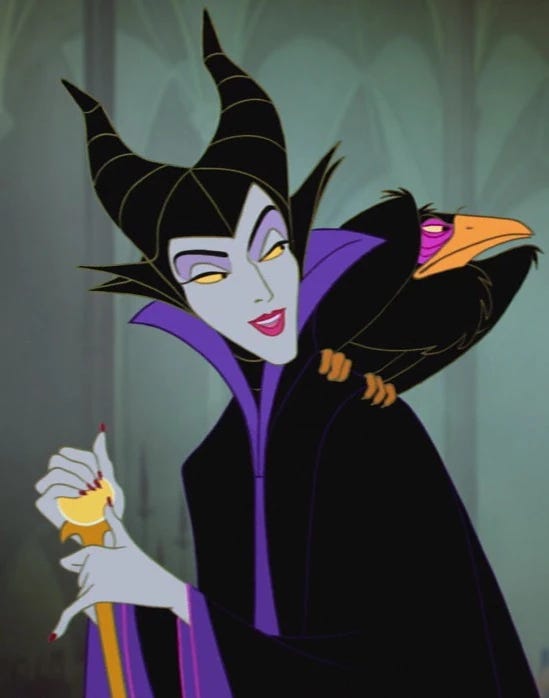
In her positive aspect, the Great Mother is wisdom incarnate. To have wisdom is to know what to do when you don’t know what to do—to know what to do in the face of the unknown.
The beneficial unknown is the source of eternal plenitude and comfort. It is “positive femininity,” metaphorically speaking, that constitutes the ground for hope itself—for the faith and belief in the essential goodness of things necessary to voluntary maintenance of life and culture. […] Redemptive knowledge itself springs from the generative encounter with the unknown, from exploration of aspects of novel things and novel situations; is part of the potential of things, implicit in them, intrinsic to their nature. This redemptive knowledge is wisdom, knowledge of how to act, generated as a consequence of proper relationship established with the positive aspect of the unknown, the source of all things[…] (MoM, p. 165)
[…] Expectation and faith determine the “response” of the unknown (as courageous approach eliminates anticipatory anxiety, and exploration makes the unexpected something valuable). (MoM, p. 167)
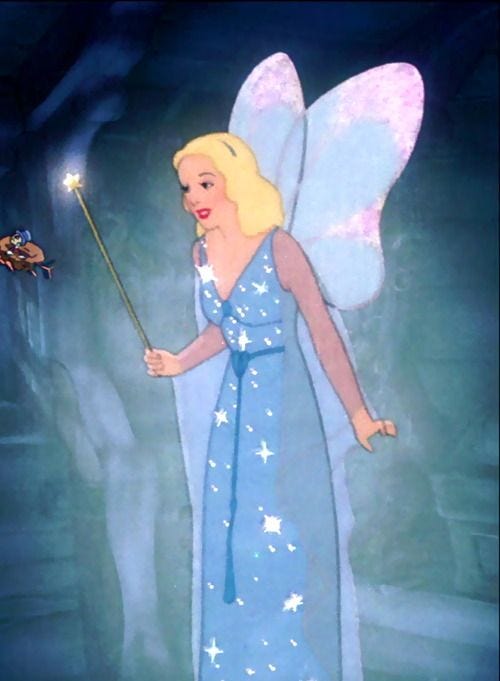
The unknown, Peterson suggests, must be approached with the appropriate attitude in order for its positive, creative, beneficial aspect to manifest rather than its negative, destructive, terrible aspect.
The mythological hero represents the pattern of action that is most likely to bring forth the beneficial aspect of the Great Mother:
The pattern of behavior characteristic of the hero—that is, voluntary advance in the face of the dangerous and promising unknown, generation of something of value as a consequence and, simultaneously, dissolution and reconstruction of current knowledge, of current morality—comes to form the kernel for the good story, cross-culturally. That story—which is what to do, when you no longer know what to do—defines the central pattern of behavior embedded in all genuinely religious systems. (MoM, p. 181)
Every great hero story is ultimately about what to do when you no longer know what to do. When Luke’s adoptive parents are murdered and he discovers his father was a Jedi, when Neo finds out the true nature of the Matrix, when Simba loses his father and thinks it’s his own fault, when Pinocchio is sent out into the world as a naive child, when Harry discovers he’s a wizard whose parents were killed by dark magic, and so on and so forth, each hero must figure out what to do when they don’t know what to do.
All of these stories are ultimately about a pattern of action for dealing with the unknown—for an encounter with The Great Mother. Joseph Campbell depicted it as the hero’s journey.
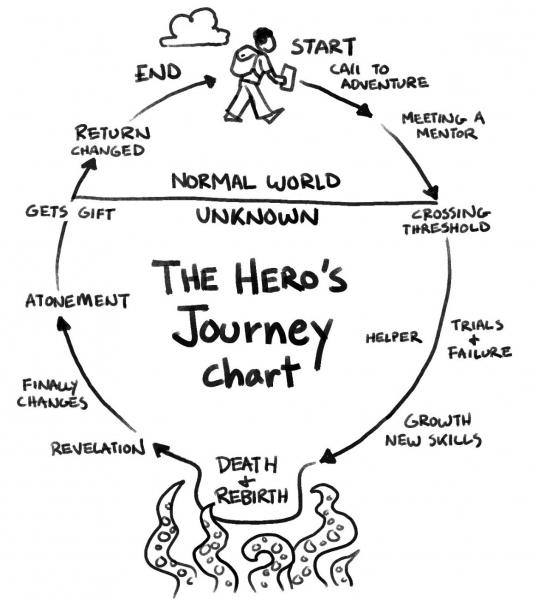
Jordan Peterson calls it the meta-mythology.

But it is ultimately about how to make the most of an encounter with the unknown:
The Great Mother is embodiment of the unknown, of the novel. The hero—her son and lover, offspring of the mystical marriage—is dramatic (first concrete behavioral, then imitative/imagistic, then verbal) representation of the pattern of action capable of making creative use of that unknown. (MoM, p. 186)
We observe people who behave admirably, imitate them, tell stories about them, then distill those stories to their essence in works of fiction (which is not equivalent to being “false”) in which the general pattern of heroic behavior is depicted.
The hero is a pattern of action, designed to make sense of the unknown; he emerges, necessarily, wherever human beings are successful. Adherence to this central pattern ensures that respect for the process of exploration (and the necessary reconfiguration of belief, attendant upon that process) always remains superordinate to all other considerations, including that of the maintenance of stable belief. (MoM, p. 186)
The problem, of course, is that this pattern is so general—and therefore generic—that it gives us little in terms of concrete practical advice for any particular situation, including how to deal with the novelty of artificial intelligence. This is necessarily the case because, if we knew precisely how to deal with some novel phenomenon, then it wouldn’t actually be novel, would it? The very fact that AI is novel means that we don’t know exactly what to do about it.
The hypothesis entailed by the pattern of the hero is that the best possible world will be brought about by acting with integrity. The hypothesis is that our collective future is ultimately determined by the integrity of each individual. That may sound trite, but integrity here doesn’t mean being a nice, obedient, good little boy. In the words of Aleksandr Solzhenitsyn, to live with integrity is to live by this credo:
Let the lie come into the world, let it even triumph. But not through me.
Why does acting heroically require integrity? In the first place, you have to acknowledge the reality of whatever you encounter, including unwelcome evidence. Everything you currently know might be wrong, and admitting that is an act of integrity. You must communicate what you discover honestly enough so that others can respond intelligently. The hero voluntarily goes down into chaos, acquires new information (or treasure, or whatever) and shares that information with the community. Deception, including self-deception, undermines every step of that process.
The archetypal opposite of the hero is the eternal adversary, who represents the pattern of action that is more likely to bring forth the threatening aspects of the Terrible Mother in an encounter with the unknown.
While the archetypal hero does not shy away from chaos and uncertainty, the archetypal adversary does not confront the unknown, but suppresses and denies it. In order to relieve the anxiety which accompanies uncertainty, the adversary avoids reality. Think of Stalin killing subordinates who gave him bad (but true) news, or academics who make up data or plagiarize. These are both ways of avoiding reality, either by suppressing the true reality or making up a false one.
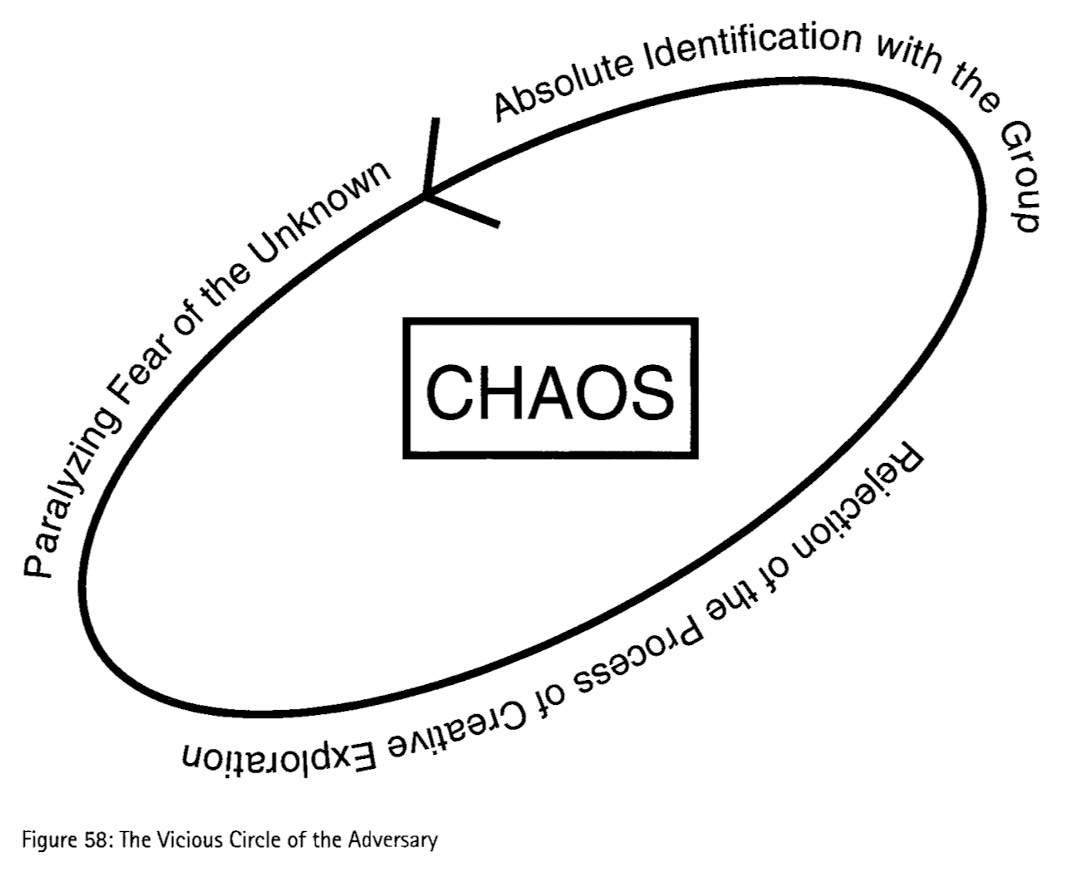
Fear of the unknown leads to the avoidance of reality. Ultimately, the adversary avoids reality by lying about it.
The liar cannot tolerate anomaly, because it provokes anxiety—and the liar does not believe that he can or should withstand anxiety. This means that he is motivated to first avoid and then to actively suppress any behavioral pattern or experience of world that does not fit comfortably into his culturally determined system of affect-regulating moral presuppositions. (MoM, p. 333)
Are the individuals with the greatest influence over the AI revolution acting heroically or adversarially? Are they acting with integrity or through deception? Unfortunately, I don’t think the answer is particularly promising. I won’t go into detail about the apparent dishonesty of people like Sam Altman and Elon Musk. Their lies and half-truths are well-documented (e.g., here and here). It’s not exactly reassuring that the most visible leaders in the AI space seem not to place much value in telling the truth.
And what about you and me? Will our own integrity, or lack thereof, play a role in determining how promising or terrifying the future will be? You can answer that question for yourself.
In Sum
Some readers may be aware that I’m working on a book called The Return of The Great Mother4, which is neither about my mom nor about artificial intelligence. The title instead refers to the archetype of The Great Mother and the return of chaos. While the advent of agriculture effectively stabilized the environment for our species, the technological revolution that is happening now has destabilized and will continue to destabilize our environment for the near future.
For most of recorded history, people lived pretty similar lives to their great great grandparents. They used similar technology, had similar roles in society, worshipped similar gods, had similar governments, and so on. For this reason, it was advantageous for cultural change to occur slowly and cautiously.
The technological revolution has changed that dynamic. My life has been radically different from the lives of my great great grandparents, most of whom were farmers with no electricity or indoor plumbing. I can be confident that whoever occupies this Earth a few generations from now will live in a very different world from the one I grew up in.
The Great Mother is back. Novelty is increasing at an unprecedented and ever-accelerating rate. We should not expect for artificial intelligence to be the only radically novel technology to appear in our lifetimes.
Are we ready for it? The first paragraph of Maps of Meaning is this:
Something we cannot see protects us from something we do not understand. The thing we cannot see is culture, in its intrapsychic or internal manifestation. The thing we do not understand is the chaos that gave rise to culture. If the structure of culture is disrupted, unwittingly, chaos returns. We will do anything—anything—to defend ourselves against that return. (MoM, p. xi)
The return of The Great Mother is not a triumph. It is promising, yes, but also utterly terrifying. If you’re not anxious, you’re not paying attention. If you’re not hopeful, you’ve given up. The future is not here yet.
I don’t mean this in terms of psychological denial, and I’m not pathologizing people who downplay the novelty of AI. I just mean that some people deny or downplay its novelty and/or importance.
I am using “novelty” in a more narrow sense here than it is typically used in everyday language.
Sam Harris explicitly does this in his discussion with Jordan Peterson. See his cookbook analogy, which dismisses the kind of symbolic interpretation discussed here as noise and confirmation bias.
I said I’d be done with it by the end of the summer, but I was wrong. It’s much longer than I thought it was going to be, and I’m not going to rush it.
Looking forward to your book! Any idea when it will come out?